The UK’s tax authority, HM Revenue & Customs (HMRC), has issued updated guidance confirming that virtually all superyachts operating in UK waters will be classified as private pleasure craft (PPC) for fuel duty purposes.

The UK’s tax authority, HM Revenue & Customs (HMRC), has issued updated guidance confirming that virtually all superyachts operating in UK waters will be classified as private pleasure craft (PPC) for fuel duty purposes. This ends widespread industry confusion regarding commercially registered or chartered vessels. [1]

Changes under the new guidance include:

The Vessel Classification Rule

  • Usage Over Structure: A yacht’s classification relies entirely on actual or intended use at the time of bunkering.
  • Corporate Neutrality: Ownership structures, corporate registration, crew configurations, and active chartering arrangements do not make a vessel commercial.
  • Private Pleasure Definition: If the owner, charterer, or guests determine the route and enjoy the vessel for leisure, it is legally a PPC.
  • Commercial Exceptions: Superyachts are only deemed commercial if contracted by government authorities or industrial entities for non-recreational services.

Fuel Duty & VAT Impacts

  • No Marine Voyages Relief: PPCs are completely barred from using duty-free or fully rebated red diesel for propulsion.
  • Propulsion Duty: Any fuel used to propel the vessel is subject to full standard UK fuel duty (currently 52.95 pence per litre).
  • Domestic Use Rebate: Red diesel can still be purchased at a lower rebated duty rate, but strictly for non-propulsion tasks like onboard heating and electricity generation.
  • Splitting and VAT: Captains or owners must explicitly declare the exact percentage split between propulsion and domestic use. Standard 20% VAT applies to the entire batch for any fuel supplies totaling 2,300 litres or more.

Compliance and Enforcement

  • Supplier Liability: Registered Dealers in Controlled Oil (RDCOs) must collect the correct declarations, charge the right tax split, and pay the additional propulsion duty to HMRC.
  • Evasion Scrutiny: Suppliers are explicitly instructed to report any suspicious or irregular declarations directly to HMRC. Incorrect declarations or missing records risk immediate asset seizure and criminal prosecution for tax evasion.

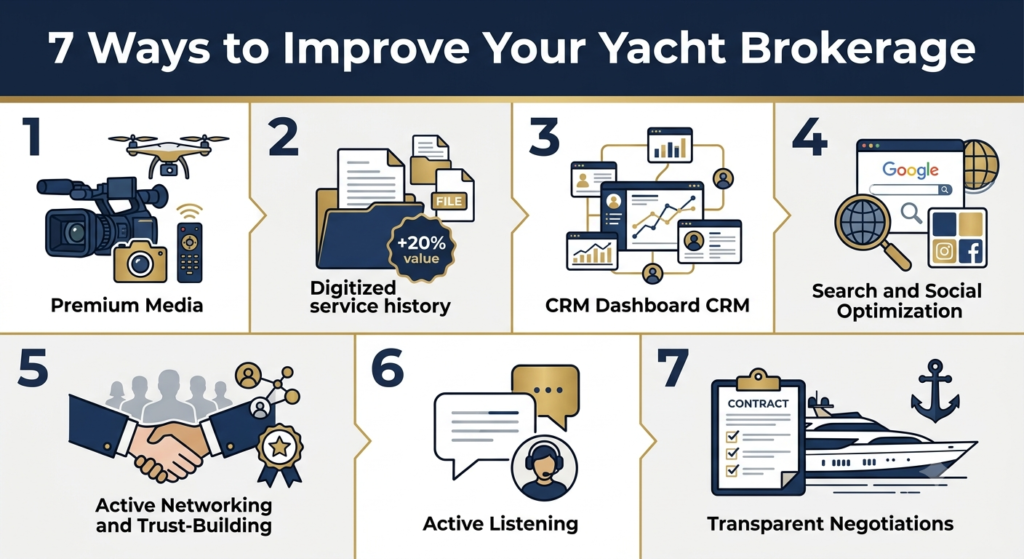
7 Practical Ways to Improve Your Yacht Brokerage

 7 Practical Ways to Improve Your Yacht Brokerage


1. Digitize Listings with Premium Media

High-net-worth buyers expect seamless remote viewing. Move beyond static photos by integrating 3D virtual tours, cinematic drone footage, and high-definition walkthrough videos into your listings. Visual storytelling builds immediate emotional connection and expands your global reach. 

2. Standardize and Digitize Service History

A fully documented service history is the single most powerful tool for verifying trust and increasing a vessel’s worth. Digitize all maintenance logs, repair receipts, and upgrade history. Comprehensive records alleviate buyer concerns and can add a 15% to 20% premium to the final sale price. 

3. Implement a Specialized CRM

Transition away from spreadsheets and adopt a marine-specific CRM (e.g., Hubspot). A proper CRM automates lead follow-ups, ensures prospective buyers receive perfectly timed communication, and tracks past clients for targeted after-sales care and referrals. 

4. Optimize for Search and Social

Enhance your brokerage’s online visibility through strategic Search Engine Optimization (SEO) to ensure high-net-worth buyers and sellers find you when researching online. Pair this with targeted social media exposure (Instagram, Facebook) to build brand awareness and showcase lifestyle imagery. 

5. Network Actively and Build Trust

While industry connections are vital, successful brokering is rooted in deep product and market knowledge. Attend industry events, participate in major boat shows, and develop strong relationships with marine surveyors, specialized maritime attorneys, and yacht captains.

6. Master the Art of Active Listening

Listening is a broker’s most valuable skill. Before pitching, carefully uncover a client’s real motivations, lifestyle needs, and pain points rather than simply showing available inventory. This shifts your role from a salesperson to a trusted, strategic advisor.

7. Navigate Negotiations with Transparency

Successfully closing a deal requires meticulous contract management and transparent communication during the survey and sea trial phases. Advise both parties clearly on findings, facilitate independent marine surveys, and handle necessary negotiations swiftly to keep deals from falling through

AYB Ideals

To be the best AYB (Associated Yacht Brokers) yacht broker,

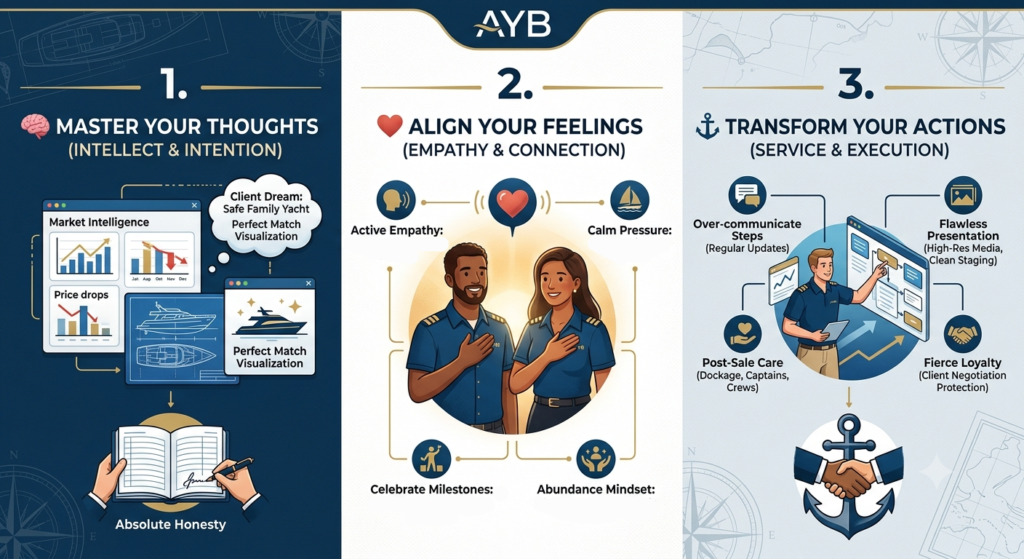
To be the best AYB (Associated Yacht Brokers) yacht broker, you must blend top-tier industry expertise with an unwavering commitment to client care. Aligning your thoughts, feelings, and actions with love means shifting your mindset from “closing a transaction” to “serving a human being.”

Here is how to master the technical and emotional aspects of the role:


Master Your Thoughts (Intellect & Intention)

  • Study the market daily. Memorize inventory, price drops, and hull designs.
  • Prioritize client dreams. See a buyer not as a commission, but as a family seeking lifelong memories.
  • Maintain absolute honesty. Never hide a vessel’s flaws just to make a quick sale.
  • Visualize client success. Focus your mind on finding the perfect, safe match for every boater.

❤️ Align Your Feelings (Empathy & Connection)

  • Practice active empathy. Understand the anxiety and excitement that comes with buying a luxury asset.
  • Stay calm under pressure. Marine surveys and sea trials often reveal stressful, unexpected issues.
  • Celebrate their milestones. Feel genuine joy when a client finally takes the helm of their dream boat.
  • Eliminate scarcity mindsets. Trust that treating people right will naturally bring abundance and referrals.

⚓ Transform Your Actions (Service & Execution)

  • Over-communicate every step. Send regular updates regarding listings, offers, and survey schedules.
  • Provide flawless presentation. Ensure every listing has high-resolution media, accurate specs, and clean staging.
  • Extend post-sale care. Help clients find reliable dockage, captains, and maintenance crews long after closing.
  • Act with fierce loyalty. Always protect your client’s financial and safety interests during tough negotiations.

A Genuine Yacht Brokers Association

The Purity of Professionalism

 Why AYB Admits Only Individual Yacht Brokers

In the global maritime industry, the line between a trade guild and a professional association is frequently blurred. Many organizations operate as broad commercial directories, welcoming anyone with a financial stake in the marine ecosystem—from boat builders and dealers to surveyors, insurers, and transport companies.

While these massive trade networks serve a purpose for general B2B networking, they fundamentally fail to protect the consumer or elevate the professional standard of brokerage.

The Associated Yacht Brokers (AYB) was founded on a diametrically opposed philosophy. AYB is not a commercial directory or a loose trade alliance. It is a strict, highly selective professional association. To maintain this status, AYB enforces two uncompromising rules: we do not admit corporate memberships, and we do not admit non-broker marine entities (such as dealers, builders, surveyors, or insurers).

Here is the strategic and ethical rationale behind why we preserve this structural purity.

1. The Purity of Representation: Why We Exclude Ancillary Marine Services

A genuine professional association must have a singular, unified focus. By restricting our membership strictly to active yacht brokers, we eliminate the inherent conflicts of interest that plague multi-disciplinary trade groups.

The Conflict Between Brokerage and Dealing/Building

At its core, the role of a yacht broker is fiduciary. A broker represents a client—either a buyer or a seller—and owes them undivided loyalty, objective advice, and transparent negotiation.

  • Boat Dealers have franchise agreements with specific manufacturers. Their primary commercial objective is to move brand-new, depreciating inventory off their balance sheets. Their loyalty is structurally bound to the factory, not the buyer.
  • Boat Builders are manufacturers focused on production volume, engineering, and margin.
  • Brokers deal in open-market assets. If a broker is also acting as a dealer, their advice is inevitably compromised by the pressure to sell their own stocked inventory rather than finding the client the absolute best vessel on the market.

By excluding dealers and builders, AYB ensures that our members are dedicated solely to the art of independent brokerage, free from the manufacturer-driven quotas that distort objective advising.

Protecting the Independence of Surveyors and Insurers

A successful yacht transaction relies on a system of checks and balances. Marine surveyors must remain fiercely independent to assess a vessel’s structural integrity without bias. Insurers must evaluate risk objectively.

When an association groups brokers, surveyors, and insurers under the same membership umbrella, it invites collusion and “soft-pedaling” during the survey phase. A surveyor who relies on a corporate association partner for referrals may feel internal pressure to downplay a vessel’s flaws to ensure the broker’s deal closes.

AYB maintains a strict firewall. By refusing membership to surveyors and insurers, we preserve the professional distance required to ensure that sea trials and surveys remain completely transparent and protective of the buyer’s safety and financial interests.

2. The Individual Mandate: Why Companies Can Never Join AYB

Perhaps the most defining characteristic of AYB is our refusal to grant corporate memberships. In our association, integrity is treated as a deeply personal attribute, not a corporate asset. Therefore, each member must apply, qualify, and join strictly in their own right as an individual.

Companies Do Not Have Consciences; Individuals Do

A corporation is a legal fiction—a set of contracts, a balance sheet, and a brand name. A company cannot sign an ethical code with genuine moral accountability; only a human being can.

When an association allows a company to purchase a “blanket membership” for its brand, it grants a seal of approval to an entity whose internal staff is constantly in flux.

Corporate Membership      precludes        Individual Accountability

The Problem of “Changing Staff”

The marine brokerage industry experiences high turnover. A brokerage firm that boasts highly ethical, seasoned professionals today might be sold tomorrow, or it may hire aggressive, untrained salespeople to meet short-term financial targets.

If AYB allowed corporate memberships:

  1. An unvetted, unscrupulous salesperson could operate under the AYB banner simply because their employer paid the corporate membership fee.
  2. The consumer would be misled into trusting an individual who has never personally been vetted, tested, or bound to our Code of Ethics.
  3. The brand of the firm would shield the bad actor from direct, professional accountability.

Personal Liability and Peer Review

Under the AYB model, when a broker joins, they do so as a self-contained professional unit of integrity. If an individual broker violates our strict code of conduct—such as hiding a known structural defect or failing to safeguard escrow funds—they are personally investigated by our peer review board.

If they are found guilty of unethical behavior, they are personally expelled. They cannot hide behind a corporate shield, and they cannot simply move to another member firm to clean their slate. Their professional reputation travels with them, ensuring that the AYB seal remains an authentic guarantee of personal honor.

Conclusion: Elevating Yacht Brokerage to a True Profession

Lawyers are admitted to the bar as individuals. Doctors are licensed as individuals. Accountants are certified as individuals.

If yacht brokerage is to be respected as a highly specialized, trusted advisory profession rather than a transactional sales gig, it must follow the same rules of personal accountability.

By excluding corporate entities and conflicting trade services, Associated Yacht Brokers (AYB) ensures that when a client sees the “AYB Certified Professional” credential behind a broker’s name, they are not looking at a paid marketing badge. They are looking at a verified professional who has personally sworn to protect their client’s dreams, finances, and safety on the water.

Chat/call The AYB Team
error: