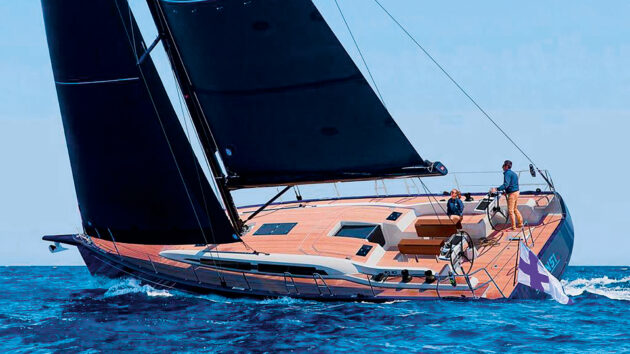
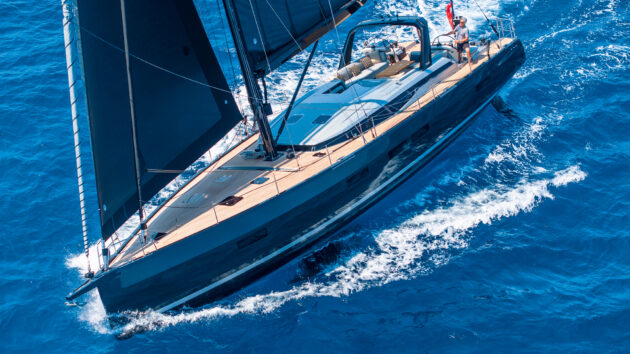
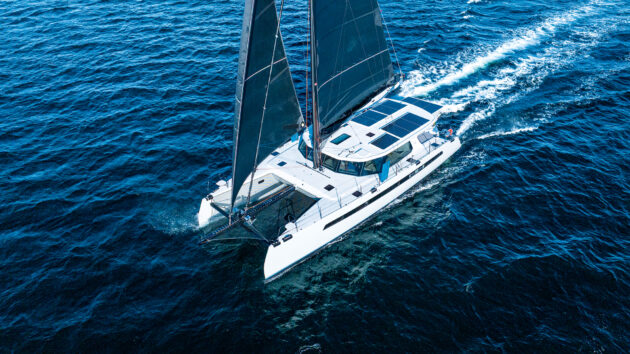
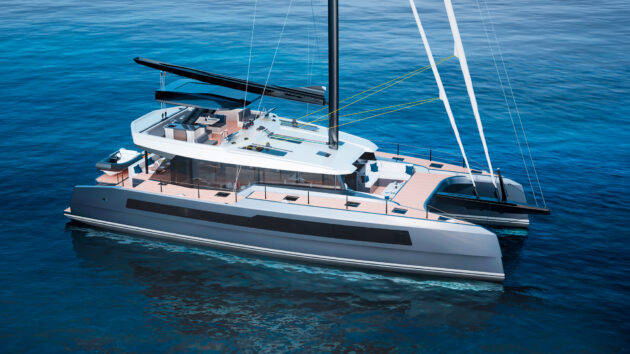
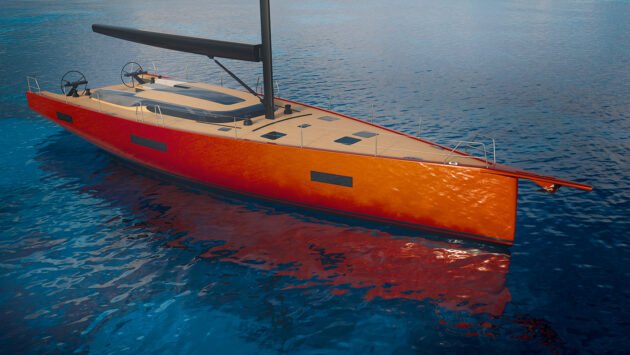
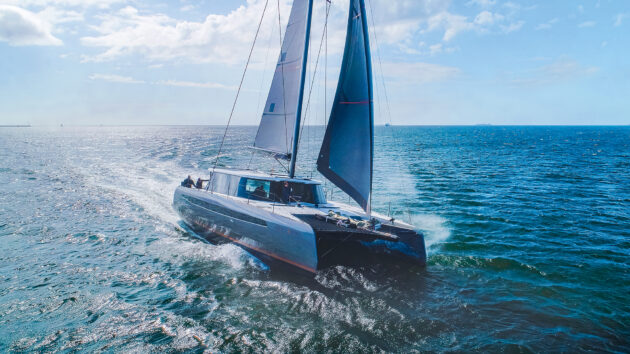
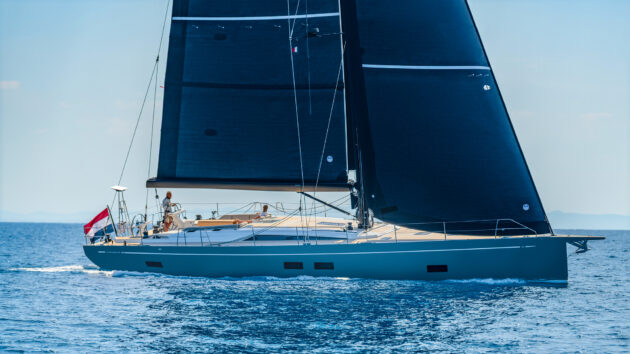
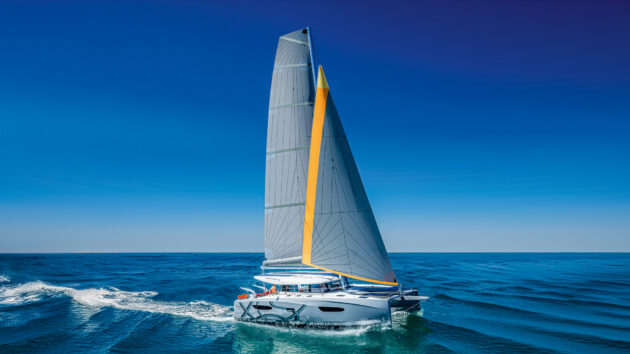
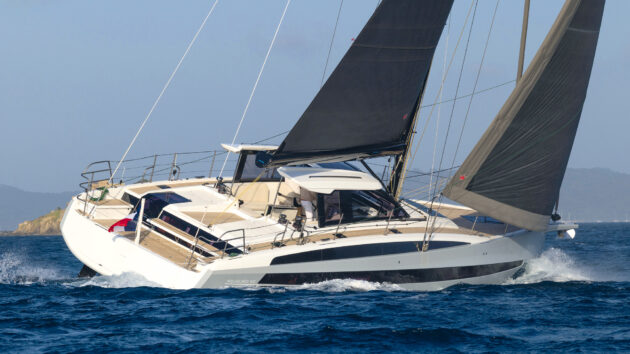
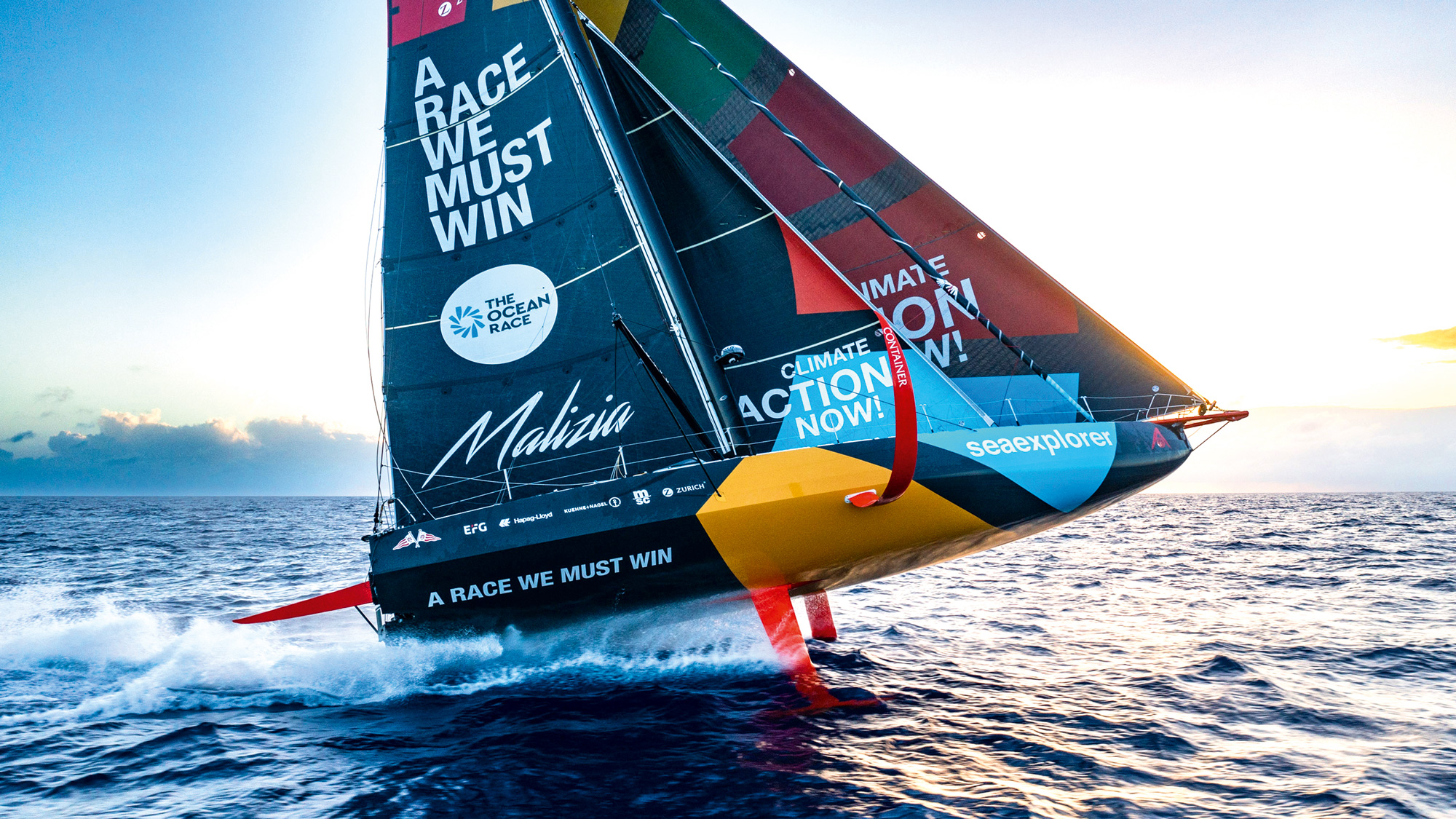
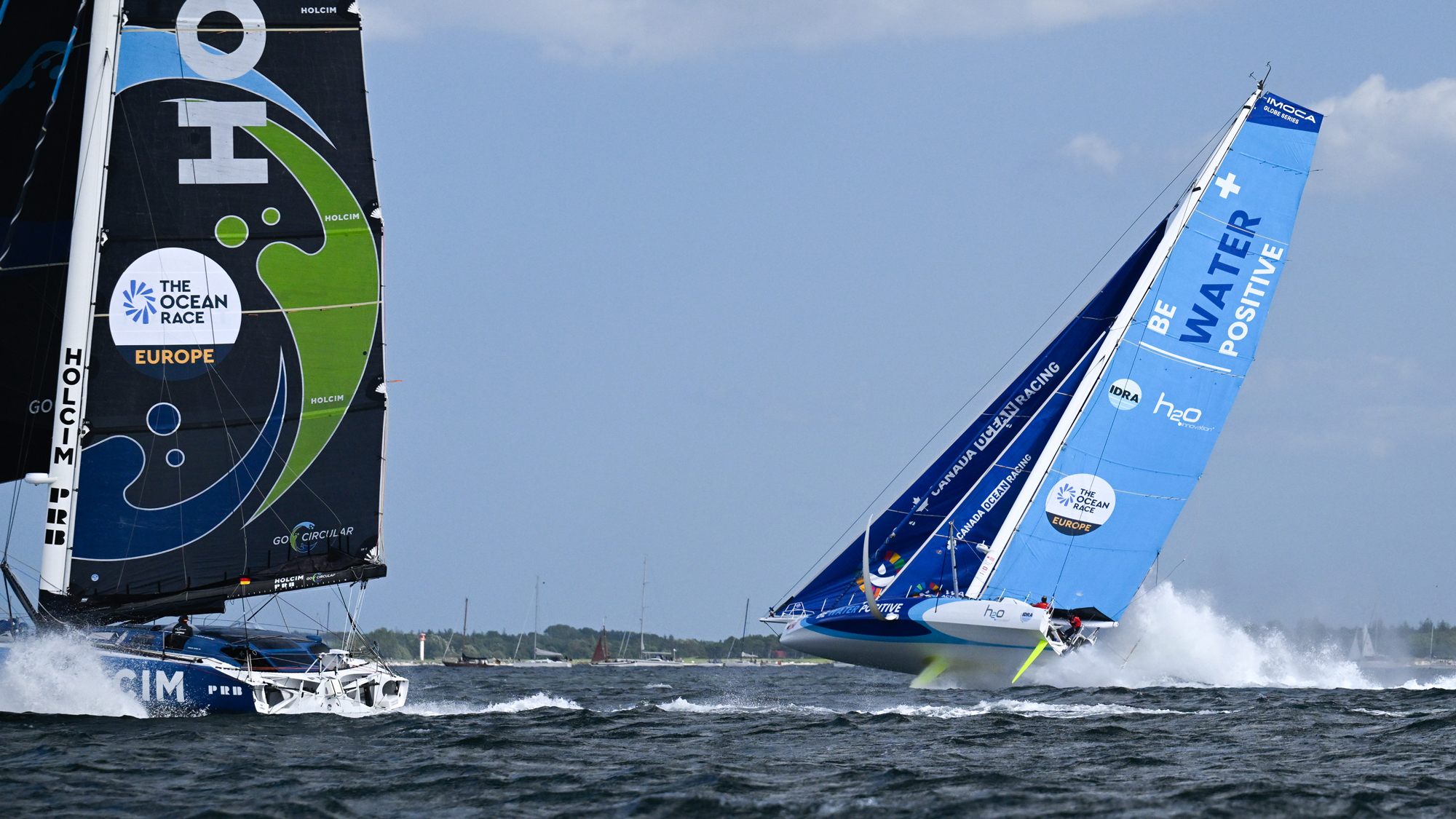
Autumn 2025 is set to be a bumper season for new yacht launches. From Sweden to Genoa, and Southampton Boat Show to Annapolis, there are International boat shows all across the north Atlantic and Med seaboards where you can view them in person. However, if you just want to attend one show in person, then Cannes Boat Show has the pick of the premieres – and of course the glamour. And there really are some glam new yachts on the lineup this year.
The Italians will steal the monohull show with their latest launches at Cannes, including the (Solaris-built) CNB 62, three from Ice Yachts, the Mylius 66RS, Grand Soleil’s latest 65 Performance and the (Italian-owned) Swan 51.
And given this Yachting World is a multihull special edition, some really exciting large cats are also making their world or European debuts.
These include two South African builds with US brand connections, in Kinetic and Balance, the former at a European show for the first time ever with its outrageously enticing KC54, and the latter with its fast and popular new Balance 580. Not big enough? Comar will fly the Italian flag with its new rapid-looking C-Cat 65, while McConaghy, the renowned carbon composite expert, is bringing its MC68.
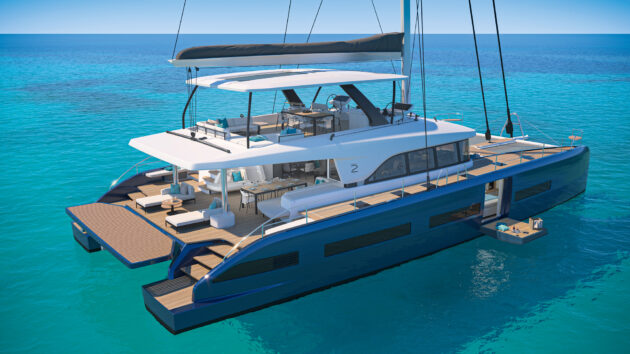
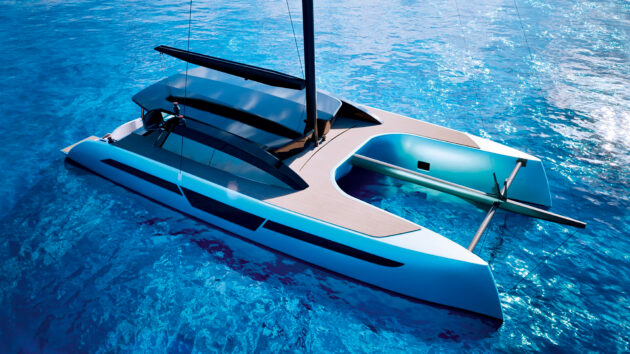
If you thought that isn’t taking up enough dock space, Lagoon has a new flagship-spaceship in its mighty Eighty 2. Or for something truly different, check out the MODX 70 and the Tortue 147 turtle boat, which bring the extraordinary to the party.
Make it past those exhibitors and you’ll still find plenty of the more approachable-sized or familiar production brands launching new models. From the Leopard 46 hybrid, Excess 13, Fountaine Pajots (tested from page 76), and Lagoon 38, to exciting new monohulls such as the First 30 (full report next month), XR 41, Wauquiez 55, plus the first of the new generation Oceanis and Sun Odyssey models from Beneteau and Jeanneau.
Let the shows commence…
Best boats in 2025’s Boat Shows

Fifty-one is a magic number for Swan, a model and marque steeped in tradition. The original Swan 51 was also the first designed by German Frers in 1981. This pairing of naval architect and prestige brand has continued to this day in one of the most successful relationships in sailing, with over 700 Frers Swans launched.
With the resurrection of the Admiral’s Cup this summer, it’s also topical to note that that first example was based on the 51ft Admiral’s Cup yacht Blizzard, while a Swan 51 was also the first yacht owned by chairman Leonardo Ferragamo.
Over the decades, the 50-footer has remained an ideal size for most types of coastal and offshore sailing.
This latest 51, which launched in July, is very much a modern luxury fast cruiser, albeit with the elegance to give it Swan’s evergreen appeal. Once again a Frers design which promotes easy and comfortable fast sailing, it has attractive, long, low lines, while today’s trend to carry full beam right aft helps add plenty of volume.
Frers has set the mast further aft too for optimum balance, while twin rudders should offer full control at an optimum performance heel angle of 20°. Three keel draughts are offered, as is a sportier setup, featuring a larger carbon mast, square-top main and runners. Things have changed on deck as well, and while this may look very go-faster sleek, it boasts a generous cockpit, a practical sail locker and Swan’s huge double-hinged swim platform to extend deck space further.
Wide coamings help swell that cockpit size, allowing for twin tables to seat up to 10 or be lowered into sunbathing beds. The three-cabin layout sees an owner’s cabin forward in which most people would be more than happy spending long periods. Different configurations can be chosen for the saloon and chart table and Swan offers a choice of four distinctive ‘atmospheres’ for the trim and upholstery.
Oh, the Bordeaux 60! I remember well poring over the first images in 2008 in the office, my colleagues then turning green with envy when I had the chance to do a three-day sea trial. Now meet the 2025 version.
Things have changed with CNB in that time. Back then, it was under the Beneteau Group’s tenureship, yet for the last four years, it’s moved to Italy and Solaris Yachts. This brought a renewed focus on CNB, the 78 an excellent representative and replacement for the older 76. Now comes the ‘baby’.
This 62 seems to take the DNA of the Bordeaux 60 – of which 46 were built – and uses the same designers to give it a more contemporary tilt. The lines are once again from the hand of Philippe Briand with a bright interior by Jean-Marc Piaton.
The goal is to offer easy short-handed cruising at speed, in elegance, and with space for plenty to join. Briand says she is powerfully rigged but will suit ocean sailing. Importantly, it is designed for a couple to operate, thanks to twin headsails and in-boom furling; in particular, the mainsail is taken to the carbon arch above the cockpit, keeping it clear of crew members. A fixed bimini can be chosen to protect the cockpit. Helm stations are further forward than past models, so benefit from this cover, with winches close behind them. This also leaves space for plenty of sunpad area above the 3m dinghy garage.
Below decks, the owner’s cabin utilises the entire section forward of the mast to create a proper home-from-home suite, with an optional office attached, while the open galley midships connects to the raised saloon.
First reports from sail trials have been very positive, which comes as no surprise given our high impressions of the larger 78.
South African designer Anton du Toit has got the lines of Balance’s new 580 spot on to my eyes – low and lean – and with nine already ordered, I’m not alone in my admiration. Two launched this spring, with the first headed for the Annapolis show in October (Windigo pictured) while the second, Swann, has already completed her shakedown passage from Cape Town to the Med to be exhibited at Cannes.
I was going to describe it as the flagship, but that title only stood for a few months as the 750 has now just splashed, in what are clearly busy times for Balance!
A “high performance luxury voyager,” is how founder Phil Bermann labels the 580. It uses a carbon-reinforced, foam-cored, full epoxy build, which results in a standard displacement under 17 tonnes, or “the lightest catamaran in her class with the highest level of interior volume and storage capacity,” he states.
High bridgedeck clearance and deep daggerboards combine with the length and light displacement to promise high average passage speeds. In flat water reaching conditions, the 580 should match or exceed 8-16 knot true windspeeds, and hit the latest teens in 20 knots. It can also be chosen with additional carbon in the coachroof, bulkheads, soles and appendages for extra weight savings and stiffness.
One of the most impressive features for fast cruising seems to be the ease with which it can be handled, thanks to Balance’s VersaHelm wheel, which cants inboard to steer from a protected position, and, in particular, the cutter rig with all three headsails on electric furlers controlled from the helm.
Previous Balance models have been bright and refreshing inside, and the 580 promises more of this with its extra-large side windows and skylights in the coachroof.
McConaghy MC68
What a sight this big cat will make. A ‘pocket superyacht’ design from Jason Ker, it builds on the footprint of the 62, but with a crew cabin, extended aft deck and flybridge options.
Hydraulic centreboards are once again neatly integrated into the hulls without swallowing much accommodation space or penetrating the decks. Together with the yacht’s E-glass, carbon composite and Corecell foam construction controlling the weight, and the fine bows and performance hulls, these boards will help with pointing and performance. The predictions of 20+ knot speeds look very attainable.
McConaghy’s preference for dual wheels set on each flank of the flybridge helps promote unobstructed views from the helms. Another benefit here is that, with no internal or bulkhead helms, the main deck’s saloon and aft cockpit feel extra sumptuous.
M2atelier has gone for an architectural and apartment style feel, but it’s very much a customisable interior. Colours, finishes and even layout can be tailored to suit.
In terms of accommodation in the hulls, three to five cabins, plus crew cabin, are offered.
Lagoon’s Eighty 2 & 38
Born out of the Bordeaux yard’s unrivalled experience, especially the success of its (already vast) Seventy 7 and combined with the design powerhouse of VPLP, Patrick le Quement and Nauta, means you can expect seriously big things out of this new super cat.
Eight can relax in the secluded forward cockpit alone. The aft swim platform can extend cockpit space by 22m2, or be used to launch a dinghy, jet-ski, or a few family members into the sea at the push of a button. The 50m2 flybridge towers above like a terrace in the skies, with twin helms and a solar-covered bimini. And then there’s the multitude of cabins, which include’s the owner’s hull door private terrace – a trump card of the 2017-built Seventy 7 worth repeating.
Talking ‘sustainability’ may seem incongruous on such a craft, but we think it worth highlighting the Beneteau Group’s continued major advances in materials and the results with resin here.
For years Lagoon has been using hemp fibre and bio resin in non-structural parts. Passing the required quality tests has allowed it to employ 100% bio-sourced resin for the entire hulls of this Eighty 2, and therefore halving the carbon footprint of the resin.
More on this in our big cat special next month.
At a more tangible level to most sailors, Lagoon will also be exhibiting its smallest new model, the Lagoon 38 which launched at the International Multihull Show earlier this year.
Italia Yachts 16.98
Performance cruising and style specialists Italia Yachts is due to launch its new flagship this autumn, but only in time for the Genoa show from 18 September.
In comparison to the Molfetta yard’s previous models, the 16.98 is designed more for cruising, and offshore/long-term cruising at that. It represents a large step up from the yard’s previous 15.98, including a lighter weight build, which features a higher percentage of composite material, a full carbon grid and carbon structures. The result is that displacement is kept to 17.5 tonnes despite a full itinerary of cruising equipment such as aircon, lithium batteries and safety systems.
The shape also differs from its siblings, with a vertical transom to include a dinghy garage, while the deck plan is simplified to encourage short-handed operation. The first hull will cruise the Mediterranean before taking part in the 2026 ARC en route to Boston.
Beneteau Oceanis 47 & 52
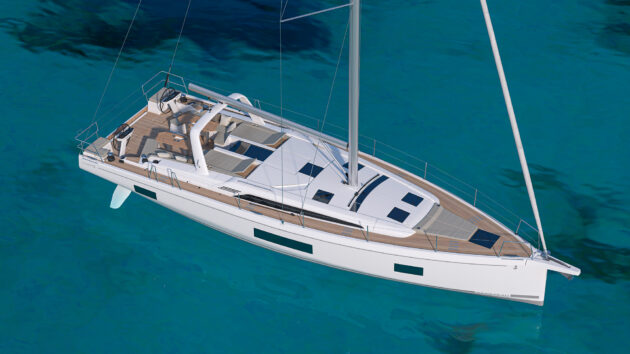
Beneteau launches the eighth generation of its Oceanis range, one of the world’s most popular cruising yachts, with the unveiling of a new 47 and 52 this autumn. Granted, they share close resemblances to the previous 46.1 and 51.1, but remember those were very successful models – particularly the 46.1, which was a clear European Yacht of the Year winner in 2019.
That Finot Conq hull shape on the 46.1, with its full-length chine that helped create a balance of space and speed, has been tweaked rather than redrawn by the looks of the renders. The L-shaped cockpit has increased in size and is offered in open or closed formats.
Multiple layout options are available – from three cabins and two heads, to five cabins and three heads – and in three different trims.
The larger sister 52, meanwhile, sports a new hull and deck, with the extra beamy aft profile the signature of America’s Cup designer Roberto Biscontini. By carrying this generous beam right to the stern, it helps create 30% more cockpit space over its predecessor. This also uses twin C-shaped cockpit benches to create a new diamond shape, promoting unhindered passage through the centre and around to the side decks.
Nauta has clearly influenced the styling on deck and below, where warm wood, quality upholstery, and Corian worktops show elegance. The forward owner’s suite looks grand. Both models are also offered as First Line versions with taller masts and increased sail areas.
Comar C-Cat 65
For sailors looking for rewarding cruising multihulls that can replicate the feel of a performance monohull, the C-Cat 48 is one of the most responsive examples I’ve sailed in recent years. And when you visit this 50-year-old family-run yard near Rome you understand why. Performance sailing is Comar’s DNA and so much of what they produce is crafted in-house.
Press information about the launch of their flagship new catamaran, a formidable 65ft of fast cruising luxury, is telling. In contrast to most yards, which tend to highlight the finishes and options available, the accommodation spaces and glitzy bits, Comar is all about the stiff and light construction.
Designed by Enrico Contreas as a high-performance sports cat, the 65 merits 40,000 construction hours, with every piece of furniture hand-made in the yard. Carbon is the predominant material choice, used with glassfibre for the hull, pre-preg preferred for the in-house-built mast, together with carbon daggerboards, crossbeams, bulkheads and bowsprit. For optimum stiffness-to-weight, Comar uses a double-cut Corecell sandwich with vacuum-infused epoxy resin.
The result on the water weighs only 18.5 tonnes, and promises uncompromised, exciting sailing in pretty much any wind. For those still interested in what’s inside, there’s plenty of space in three or four guest cabins plus one crew, with an aft owner’s suite, but that’s about all I can tell you so far! This is one we’re looking forward to seeing and sailing.
Ice 64 Explorer/66 Sport/70RS
Ice is very much an archetypal Med fast cruising brand, which helps make this new 64 Explorer all the more distinctive, with its blend of go-fast meets purposeful styling. The Felci design offers something really different for the Milan yard, a performance yacht designed for ocean cruising, with energy and operational independence.
A carbon T-top and bimini encloses an otherwise sleek cockpit. This structure is multi-functional, providing crew protection, and housing the mainsheet traveller, solar panels, and rainwater collection drains. The arch also serves as a crane to lift the dinghy onto the wide sugarscoop-style transom.
Inside is a three-cabin layout and a dinette opposite the midships galley, which can transform to a berth. The crew cabin has access to the engine room, and there’s a multifunctional area which includes a large workbench, laundry and heads to suit extended periods of living aboard.
The first of two 64 Explorers in build will be on display at Cannes alongside the latest versions of the Farr-designed Ice 66 Sport and the Felci Ice 70RS, both of which we have reviewed and shot on video in recent years. The 66 marries powerful Farr lines with chic Italian styling by Micheletti & Partners, while this RS version of the Ice 70 is a sub 30-tonne Felci design with a Cariboni lift keel, and is created to compete at international regattas without compromise on comfort.
Kinetic KC54
Having shown and written about this Kinetic catamaran and its KC62 larger sister over the years, from when the brand was in concept stage, but still never having had the chance to board one, we are particularly excited about the prospect of doing so now, with Kinetic making its European debut at Cannes. It will have a KC54 at the show and potentially one anchored in the bay for sea trials.
Kinetic really hits the niche of luxury crossed with high performance. Built in Kynsna, South Africa, its catamarans offer fast cruising quality, and use equipment from top suppliers.
The KC54 is offered with Performance or Turbo packages and owners can choose slab-reefing on V-booms or electric in-boom furling.
Grand Soleil 65 Performance
Following in the footsteps of Grand Soleil’s recent large and exceedingly cool models, the 72 and the 65LC (featured at length last August), comes this Performance version of its 65. It forms part of the brand’s semi-custom Plus line of models over 60ft and made its debut in May.
The Matteo Polli and Nauta design is naturally similar to the LC, albeit with a different deck line and alternative interior layout. Gone are the panoramic windows and raised saloon in favour of a sleeker look and saloon at the same level as the forward accommodation.
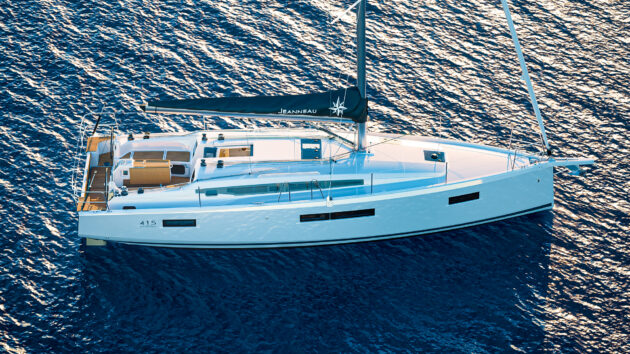
Jeanneau Sun Odyssey 415
This first model of the 9th generation of Sun Odyssey has a tough task in replacing the highly popular Sun Odyssey 410, but trusting that to the proven design house duo of Marc Lombard and Jean-Marc Piaton gives Jeanneau an optimum chance of success.
Many of the features which worked and we saw before are repeated in a similar style yacht, including the reverse stem and walkaround side decks. The 415 is offered with four sailplans and three keel options. Its interior looks light and spacious in the saloon, there’s an L-shaped galley, and it’s offered with two or three cabins and one or two heads.
In a triple showing for Excess, the Beneteau Group brand will display its latest Excess 13, which we have shown a couple of times in these pages, alongside its smallest and largest models, the Excess 11 and 14. We toured the 13 at the International Multihull Show and it offers an exciting blend of space and performance with plenty of bright accommodation for fast cruising.
This proved a showstopper at its debut in Düsseldorf in January, and our subsequent video tours have been very popular. The novel Lombard-designed hull features distinctive reverse sheer and chines combined with a protected and covered central cockpit. If the raised saloon looks inviting, wait until you see the class-leading space in the aft owner’s suite, complete with its own companionway access onto the aft deck.
If you enjoyed this….
Yachting World is the world’s leading magazine for bluewater cruisers and offshore sailors. Every month we have inspirational adventures and practical features to help you realise your sailing dreams.
Build your knowledge with a subscription delivered to your door. See our latest offers and save at least 30% off the cover price.

 If you enjoyed this….