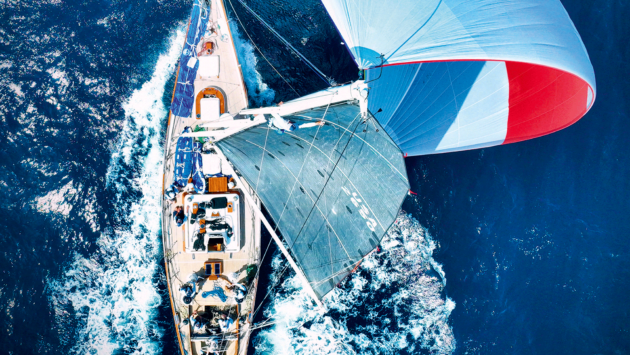
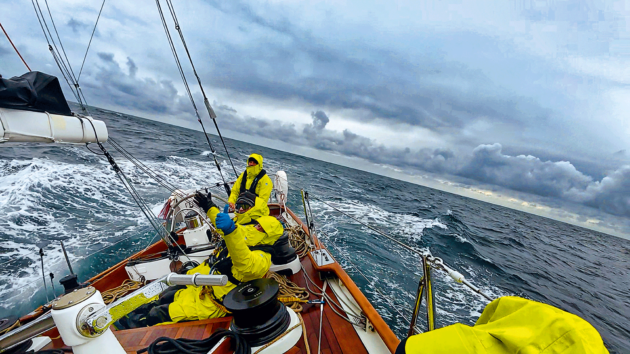
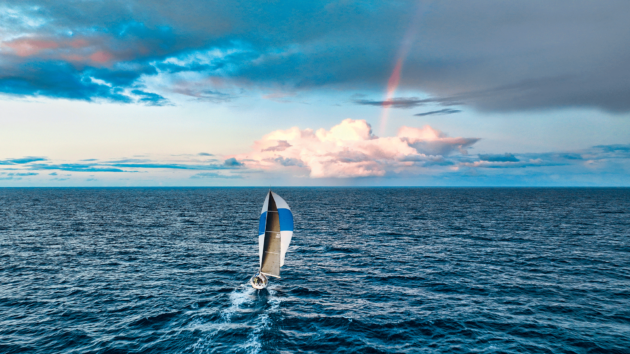
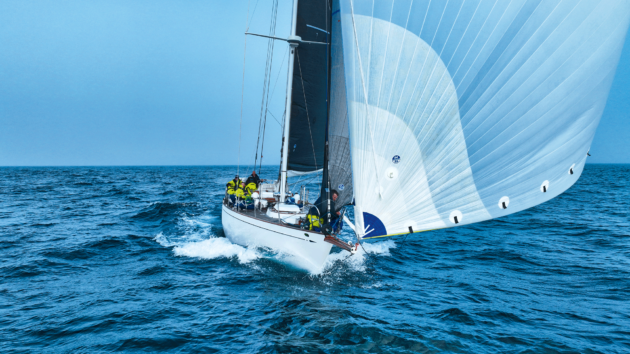
The boutique superyacht builder: Southern Wind strikes “The Perfect Balance”

Southern Wind superyacht builders unveil a new brand identity, which captures the marque’s balance between heritage and innovation.

For Southern Wind, balance is everything.

It’s in the finger-tip control as you take the helm of a high-performance sailing machine, combined with the luxurious comfort and elegance onboard a superyacht. It’s in the leading edge carbon-fibre construction, balanced with 30 years of experience building yachts amply able to contend with the oceans’ sometimes ferocious weather. And it’s in the freedom and flexibility of their smart-custom design approach, balanced with the efficiency of carefully optimised build processes.

Central to Southern Wind’s ethos is this blend of innovation and moderation. The company is always at the leading edge, but never chasing the bleeding edge. It’s a guiding principle inspired by Aristotle’s timeless wisdom: “In Medio stat Virtus”, which shapes every aspect of the company, from the design and construction of its yachts to its own workplace culture.

Boutique offering

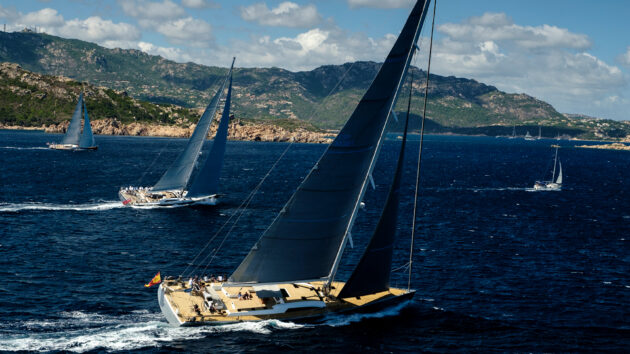
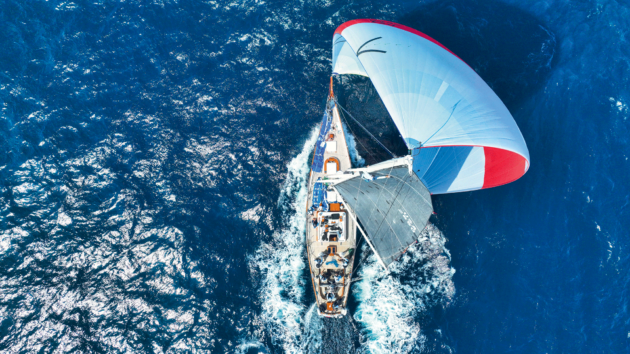
Southern Wind has been building luxury sailing yachts since 1991, and has launched over 35 yachts in the 30m+ range in that time. Four incredible yachts are currently in build, including the third SW108, the first unit of the brand new project SW100X, and the phenomenal new flagship SW123, for delivery in 2027.

This September the shipyard unveiled a new brand identity: “The Perfect Balance.” But it’s much more than just a new logo.

The superyacht world is changing, with increasing numbers of yacht builders now merging into large companies. Southern Wind – who have never been afraid of doing things a little differently – are keen to emphasise that they’ve chosen an independent a different path, intentionally remaining as a boutique company that offers its owners a much more personal approach.

Southern Wind CEO Marco Alberti

“While our brand has evolved over the years, we’ve never lost sight of who we are: not only a shipyard, but a partner offering unforgettable yachting experiences,” explains Andrea Micheli, CCO of Southern Wind. “But we felt it was time to describe more clearly who we are today and where we’re headed in the future. This rebranding serves as a reflection of our current and desired positioning in the sailing superyacht industry.”

Southern Wind pride themselves on the fact that ownership is a full-circle process, from design through the entire life of the yacht, with services including After Sales, Yacht Management and Charter Management.

“This new chapter expresses who we are and the values that define us,” adds Micheli. “We guide our clients on a complete journey – starting with concept, moving through smart customization, and continuing with a range of bespoke services after delivery.

“Our community is exclusive by nature, yet inclusive at heart. We welcome passionate sailors of all levels – from beginners to seasoned experts, from clients to crew members – inviting them to become part of a close-knit family of like-minded, understated individuals.”

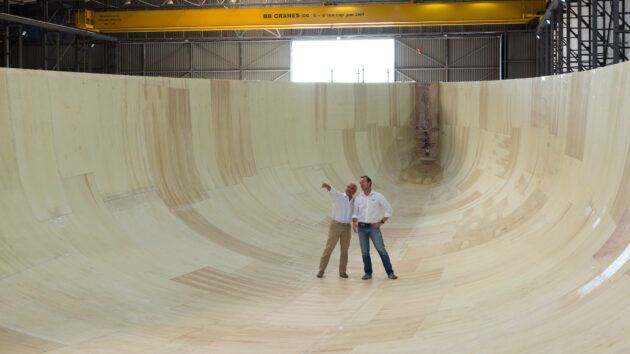
Inspecting a new mould

Continuity and family

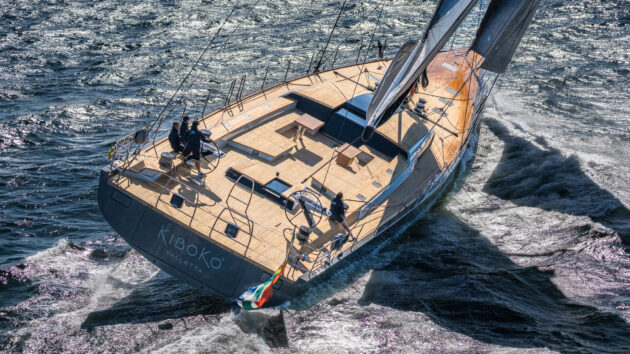
The Southern Wind family holds its members close, as evidenced by the launch of the SW108 Kiboko 4, a new yacht for a previous SW105 owner – see Toby Hodges’ gripping video of sail trialling the SW108 off Cape Town in strong breeze.

So while this rebranding is not just a new logo, fittingly the new monogram captures both a sense of continuity and family, with ‘Southern’ and ‘Wind’ on a single line, and a circular monogram that represents the community of passionate sailors. It was unveiled during a memorable Southern Wind Family Dinner at the beautiful Atzaró Agroturismo deep in the Ibizan countryside, during the prestigious Ibiza JoySail regatta.

Explore the New Southern Wind

To learn more about Southern Wind’s journey and explore the brand’s new look, visit sws-yachts.com/ and follow us on Facebook, YouTube, Instagram, and LinkedIn.

Adapting to the elements – A revolution in thermo-regulating technical clothing

How do animals remain comfortable and regulate their temperature across a wide range of temperatures and activity levels? Their fur is a key to the answer. It has a naturally open structure, promoting airflow when they are active, yet traps a large volume of air when they are resting.

Could an insulating fabric with similar properties make sailors more comfortable when faced with varied conditions and engaged in a typical mix of short bursts of sustained effort, followed by long periods of inactivity?

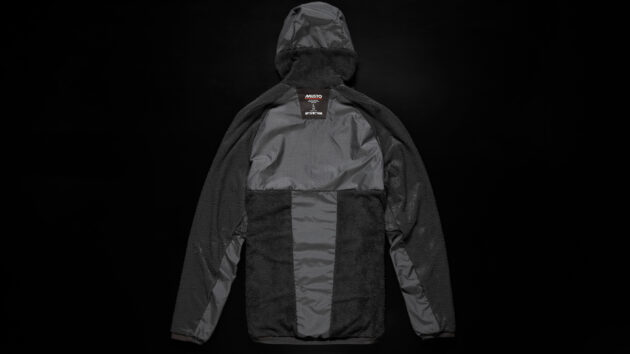
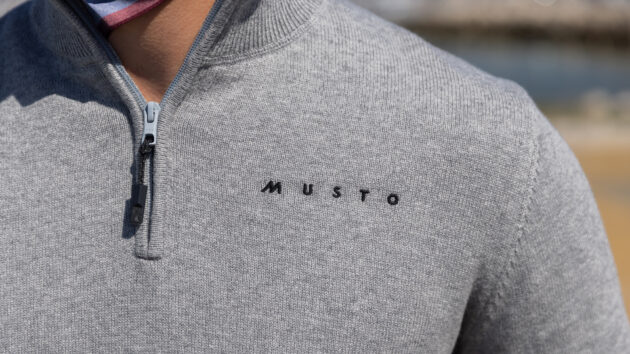
Musto has never been afraid to push boundaries to new levels and this is exactly what it set out to achieve with its new EVO Autumn/Winter 2025 collection. An extensive development process focussed on using synthetic materials in a novel way that replicates the benefits of natural fur.

The company is also renowned for extensively testing new innovations to demonstrate their effectiveness. For independent verification of new Primaloft Active Evolve fabric used as an insulating material in the EVO Thermal Primaloft Waterproof Jacket Musto turned to Dr Andy West at the Institute of Applied Sciences at the University of Chichester.

He led a team of researchers who benchmarked the EVO Thermal Primaloft Jacket against two established Musto products: the Sardinia jacket that’s intended for warm-weather use and the Corsica jacket, which is optimised for cooler climates.

Test subjects had to swallow a biometric sensor that would track their internal body temperature and were then placed in a temperature controlled chamber, going as cold as 1°C and as warm as 8°C. Two additional sensors on chest and forearms helped to track body temperature changes during light and moderate activity.

At the lower temperature the EVO Thermal Primaloft Jacket performed as well or better than the fleece lined Corsica jacket, while the same was true at the higher temperature when compared with the Sardinia jacket. The process therefore validated the efficiency of the new insulation over a wide temperature range.

Sailors can therefore be confident of the performance of this impressively flexible garment that bridges the two existing single-purpose jackets and brings a new level of comfort and performance, both for racing and cruising.

In addition to the men’s EVO Thermal Primaloft jacket, there’s a versatile EVO Polartec 3-in-1 Adapt Waterproof Jacket that’s styled for both men and women and has a waterproof shell, plus removable fleece liner, offering flexible layering options for changing conditions.

These advances represent an important step forward in materials science and technology, promising sailors greater comfort in changeable weather, or when long periods of inactivity are interspersed with short bursts of intense activity.
They even offer the prospect of helping to improve the performance of a raceboat before it even leaves the dock. It has long been known that exposure to cold during pre-race preparation reduces mental sharpness, with a lasting impact on performance on the water. Therefore clothing with a high degree of thermal regulation, that you can also wear while racing, can deliver improved racing results.

The collection extends to more than a dozen items, with pricing from £25 up to £225. In addition to the outerwear there’s a full range of technical garments, each has a body-mapped construction that optimises warmth, breathability and freedom of movement.

The EVO Windproof Knit, for example, has a two-layer windproof lining beneath a merino wool and cotton outer fabric. Meanwhile, lighter mid-layers in the range use similar thermoregulating principles to maintain core warmth without overheating.

Find out more about the whole Musto EVO Autumn/Winter 2025 collection at musto.com

Sailing the Transatlantic Race on Hound: ‘Hound is a poster child for a bygone era of yacht design’

Sailing the Transatlantic Race on the iconic 1970s sloop Hound was a tonic for Conrad Humphreys

It’s early morning on 25 June, and last night was tough. The wind peaked at 32 knots and up on deck the mood was a little sombre. Down in the galley area was the A4 gennaker, soaking wet after being recovered from the sea.

The heavy air sail had burst its zippers before it was on the halyard lock, filling prematurely and loading the halyard. As the on-watch crew tried to winch it up the final metre, the halyard snapped. After I’d shouted for assistance, the soggy sail was recovered back on board, but was in two pieces.

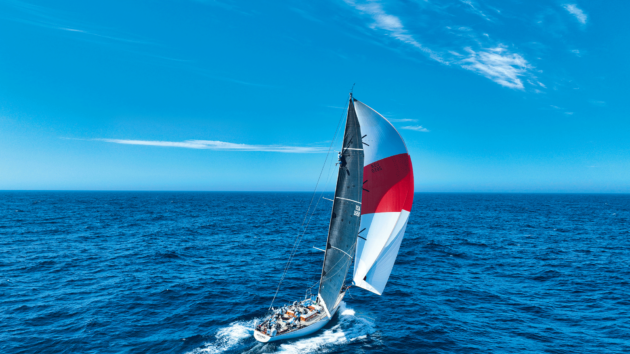
Modern sails and classic lines make Hound a fast all-rounder

Modern sails and classic lines make Hound a fast all-rounder. Photo: Nicholas Horbaczewski

I ran the tapes to see if it was repairable, but sadly the A4 was done. I glanced at the nav computer, we needed that sail to stay with the fleet riding the slow-moving front on the longer easterly route. Without it, we’d fall off the front and into the light winds behind it. We needed a revised strategy.

Ed Cesare and I share the navigating duties on Hound, a beautiful 1970s Aage Nielsen sloop. Built by the renowned Abeking-Rasmussen shipyard, Hound is a poster child for a bygone era of yacht design with her varnished toerails and elegant overhangs.

Sailing the Transatlantic Race: Race-winning upgrades

Hound is owned and skippered by Dan Litchfield, who acquired the yacht in 2020. Together with Tom Stark, Hound’s boat captain, he has overseen a series of race-winning upgrades, including a new, taller carbon mast, a bowsprit and a new North Sail inventory that looks to exploit some of the gaps in her performance polar.

Not just the prettiest boat on the dock, Hound’s classic design now masks an exceptional all-round performance, with no notable performance weakness despite her 25 ton displacement.

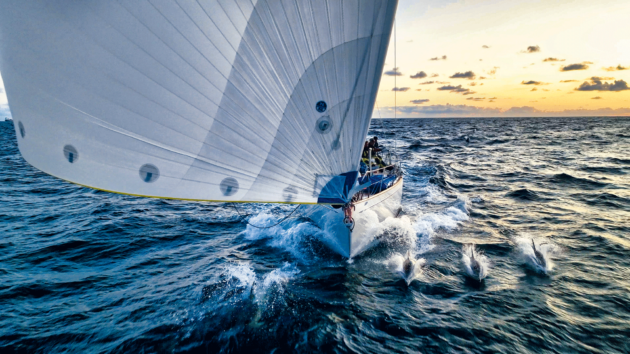
Silky smooth sailing and dolphins for company.

Silky smooth sailing and dolphins for company. Photo: Nicholas Horbaczewski

Mid-Atlantic, we quickly ran a new route on Expedition with the latest ECMWF model forecast and it showed the northern route was just a few hours slower than the eastern option. It would put us closer to the ‘great circle’ route and keep us in the stronger north-westerly winds behind the front.

After the A4 sail damage, a noticeably shaken watch had hoisted the jib-top and we were now reaching into an increasingly building sea state. As our watch came back on deck, the decision was already made to put the smaller fractional A3 gennaker up and get ripping along again.

A chance to relax in light airs.

A chance to relax in light airs. Photo: Nicholas Horbaczewski

It’s never an easy decision to split from the fleet, but all three of the yachts ahead of us in our class were lighter, more powerful downwind flyers and would likely stay ahead of the front in fresh south-westerly winds. Ed and I thought it unlikely we could keep up and, once that was clear, Dan made the quick decision to back ourselves on the northern route.

Article continues below…

Dodging windmillls

The RORC Transatlantic Race takes the fleet from Newport, Rhode Island, to Cowes, UK – a month before the centenary edition of the Rolex Fastnet Race (for which I would also be navigating on Hound).

The Transatlantic started at 1300 EDT on 18 June with the line shrouded in thick fog. It was just possible to make out the Castle Hill lighthouse, which marked one end. We had a great start and spent the first night sailing right through the middle of the partially constructed Vineyard Wind Farm (the first commercial wind farm in the US).

Hound didn’t win the RORC Transatlantic Race, but Conrad Humphreys still found the adventure was an enlightening experience

Hound didn’t win the RORC Transatlantic Race, but Conrad Humphreys still found the adventure was an enlightening experience. Photo: Nicholas Horbaczewski

We weren’t the only ones to sail right through the middle of the farm, and I soon heard another former Global Challenge skipper and great friend Dee Caffari on the radio, talking to the wind farm operator, who seemed bemused as to why we’d knowingly sail through a wind farm in thick fog.

Like Dee, we had sight on both radar and AIS of the 62 giant turbines that were spaced one mile apart. Unknown to both of us was the fact that many were not yet in operation and not on AIS!

Once safely through we set about crossing the Nantucket Shoals, where the first of two waypoints were set to keep us to the south of the North Atlantic Right Whale area of conservation – an initiative where science is increasingly being used to help keep sailing boats away from sensitive whaling conservation zones.

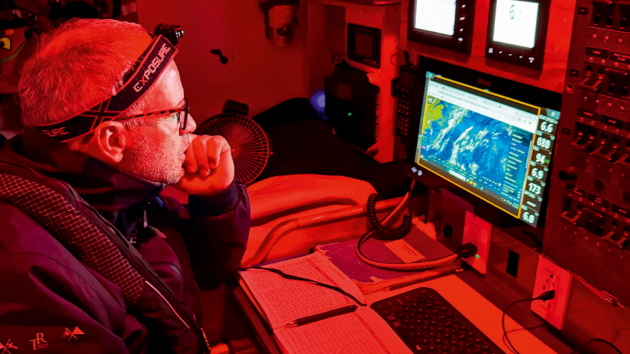
Humphreys studies the weather

Humphreys studies the weather. Photo: Nicholas Horbaczewski

From Nantucket, we began a 1,200-mile drag race to the southern ice limit waypoint Alpha. Having watched fellow IRC competitor Moana extend a little in the early stages of the leg, sailing in the north with better pressure closer to the ice limit, we opted to also leave any favourable Gulf Stream early and look for better pressure.

As the high pressure took hold, Moana and the two other class leaders (Haspa Hamburg and Ikigai) found themselves in the centre of the high, so we made some really good gains around the outside with a track along the ice limit. By the time we reached Point Alpha we were back leading our class in IRC.

Route choices

On Hound, we sail with two watches, with Ed and I sharing the navigation duties. Using Starlink, we can grab regular GRIB weather files (ECMWF and GFS global models), satellite imagery, synoptic charts and some local observations (normally from buoys or other ships) We would then run the models using Expedition and colour code our routes, before spending time doing some analysis, based on our actual observed conditions.

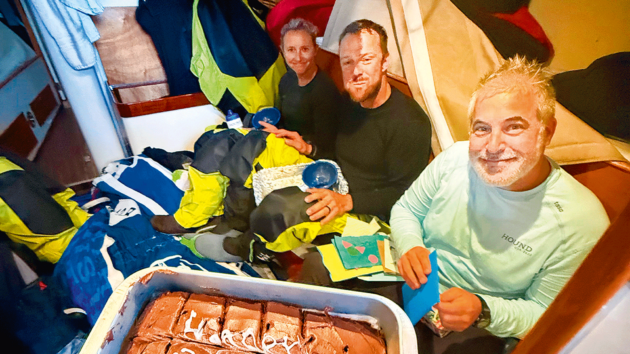
Straight from the oven.

Straight from the oven. Photo: Nicholas Horbaczewski

We’d also run some routes for our competitors, which are tracked via Yellowbrick. At Point Alpha there was a nice jet of Gulf Stream current running to the north-east (up to 2.5 knots), but after that the routeing suggested we continue sailing eastward just ahead of a cold front, rather than the more typical great circle course to the north-east.

There was a danger with following that route, that unless we could maintain high averages, we might fall off the back of the front.

Ed and I considered that if we couldn’t maintain high speeds, we might be better gybing back onto port towards the rhumb line, so we ‘forced’ the routeing with an extra mark on the great circle course – the delta was only three hours, which didn’t seem a lot, considering there was a risk that if we dropped off the front, we’d be forced to gybe north in much lighter winds.

Original 1970s coffee grinder is still in use.

Original 1970s coffee grinder is still in use. Photo: Nicholas Horbaczewski

Splitting from the fleet was not a decision I wanted to take, albeit we were the slowest of our class and the most likely to drop off the front first.

We agreed to push on with our eastward trajectory and look at the next weather update in six hours’ time. The breeze was steady at 20-25 knots and the on-watch decided to set the A4 gennaker. It was moments later that we were back on deck fishing the sail out of the water.

For the first few days, confidence built in our revised strategy. With the A3 we were quick and, while the sea state was challenging, we found a mode that was fast. However, our friends in the east were also making good speeds, pointing their bows directly at the UK. We could only hope that the front would overhaul them.

Modern sails and classic lines make Hound a fast all-rounder

Modern sails and classic lines make Hound a fast all-rounder. Photo: Nicholas Horbaczewski

Last chance

Twenty-four hours later our speed slowed as the low pressure moved away and high pressure moved in. A powerful secondary low formed on the trailing edge of the front and this was the killer blow.

Fresh Atlantic sailing.

Fresh Atlantic sailing. Photo: Nicholas Horbaczewski

It provided a welcome slingshot for the eastern pack, allowing them to sail fast downwind almost all the way to the western approaches. We faced some headwinds on the northern side of the low, but were too far away to pass under it. This was sadly the nail in our coffin. We could only watch as Moana, Haspa Hamburg and Ikigai disappeared over the horizon and we were left languishing.

What did surprise me, however, was that despite these light downwind conditions Hound was still making good speed. We had a few hours where the wind shut down completely, but in 6 knots of wind we could sail very deep at 130-150° TWA with 7 knots boatspeed. Which, for a 25-tonne yacht, was impressive!

The sailing was silky smooth and we experienced some of the best sunrises and sunsets of the trip. We were also treated to an awesome display of wildlife with numerous whale and dolphin sightings.

Drone shot as Hound heads into a sunset.

Drone shot as Hound heads into a sunset. Photo: Nicholas Horbaczewski

It was magical sailing and I think we learned a lot about the boat’s performance during that final week that would prove invaluable for the Rolex Fastnet Race later in July.

As we closed in on the Isles of Scilly, we got our first glimpses of the infamous Bishop Rock Lighthouse and the low lying island of St Agnes. From there we passed Wolf Rock and finally closed in on the Lizard, passing it on 4 July, to mark our official time for crossing the Atlantic.

From the Lizard to Start Point is my back garden, having spent many wonderful training sessions between Plymouth, Lizard and Start Point as I prepared for the Vendée Globe. Plymouth has been home since 1994, so I always feel a great sense of nostalgia arriving back into these waters. Luckily for me, the wind lifted us into the bay, so we passed within a mile of Eddystone Lighthouse.

Carbon mast and a bowsprit mean Hound can carry more sail area.

Carbon mast and a bowsprit mean Hound can carry more sail area. Photo: Nicholas Horbaczewski

Raiding party

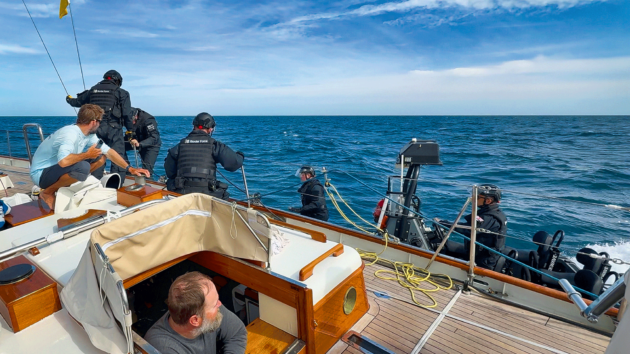
We gybed back onto starboard as the wind continued to back around to the south-west and build. We peeled to the A2 gennaker off Start Point and Tom appeared with the customs flags, a yellow for ‘Q’ and the Red Ensign. Moments later, a large grey Border Control vessel passed by, I guessed en route to Plymouth.

But they paused behind us and then proceeded to launch their RIB, which was aimed straight at our stern wake.

UK Border Force officers climb aboard Hound.

UK Border Force officers climb aboard Hound. Photo: Nicholas Horbaczewski

I called them up on the radio to ask what their intentions were and to see how we might assist, but before I had a chance to finish the call, they’d rammed the RIB alongside and four border control officers hauled themselves on deck.

They then searched the vessel while the person in charge asked a series of questions as to what we were carrying. I was quite surprised – boarding a yacht while racing under spinnaker at speeds of over 10 knots was dangerous and unnecessary.

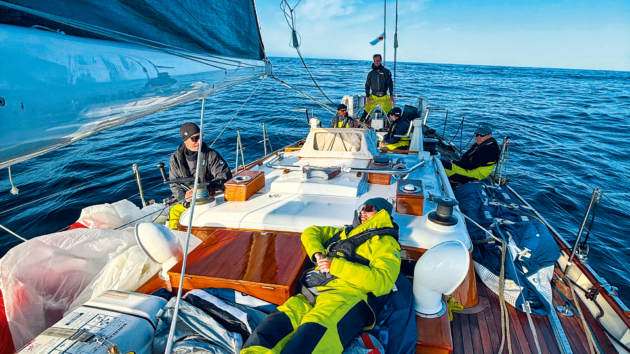
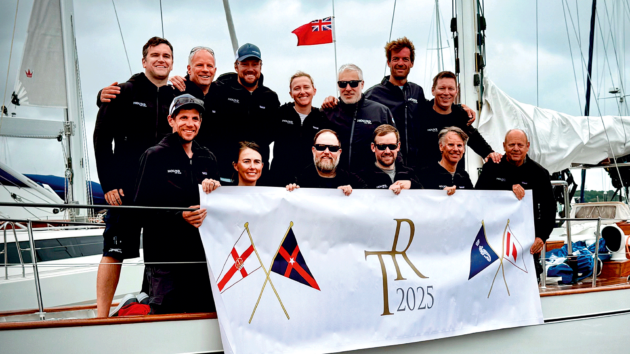
Hound’s RORC Transatlantic Race crew

Hound’s RORC Transatlantic Race crew. Photo: Nicholas Horbaczewski

A quick search online would have identified the boat, the American flag and the fact that were racing in the Transatlantic Race. We were also flying a Q flag, which should have indicated we were complying with Customs regulations. Then, having established our credentials they left via the high side of the yacht, almost causing an incident with one of their own team. I was left pretty flabbergasted after the raiding party left.

The final run up the Channel was great fun, with winds of 20 knots from the south-west, we gybed in towards Portland Bill and then picked up a favourable wind shift to lay the Needles.

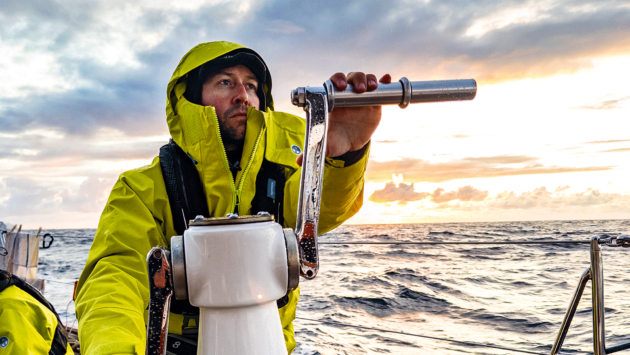
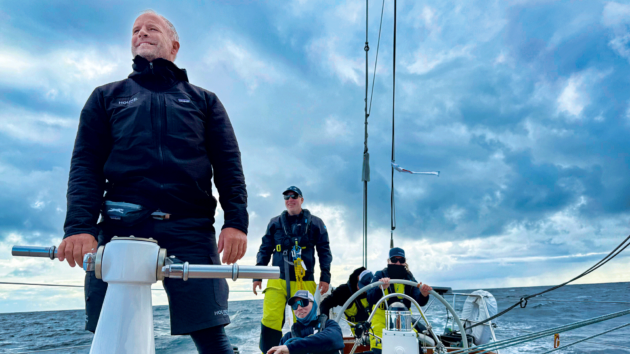
Humphreys takes his turn on the coffee grinder

Humphreys takes his turn on the coffee grinder. Photo: Nicholas Horbaczewski

By this point it was dark, so my American team mates weren’t able to see the famous rock formation at the entrance to the Solent, but I could sense their excitement as we swept past Hurst Castle with the flood tide and finally crossed the line off Cowes to finish the Transatlantic Race in an elapsed time of 16d 08h 49mins.

Overall, this was one of my best transatlantic crossings. Hound proved herself a wonderful yacht to race. The sunsets, the wildlife, the banter and the exquisite food made for a fine adventure and I was looking forward to our next race in July, the Rolex Fastnet Race.


If you enjoyed this….

Yachting World is the world’s leading magazine for bluewater cruisers and offshore sailors. Every month we have inspirational adventures and practical features to help you realise your sailing dreams.

Build your knowledge with a subscription delivered to your door. See our latest offers and save at least 30% off the cover price.

Note: We may earn a commission when you buy through links on our site, at no extra cost to you. This doesn’t affect our editorial independence.


Everything you need to know about high performance autopilots

Autopilot technology is evolving at a rapid pace, with the best of today’s units offering exceptional performance, both for racing and cruising. Rupert Holmes reports

It’s 0230 in the morning and we’re sailing close-hauled mid-Channel with the breeze gusting to 30 knots. In the strongest puffs our heading feathers up a little into the wind to avoid excess heel, while simultaneously maximising VMG. Equally, in the lulls we bear away a little to power the boat up and build speed.

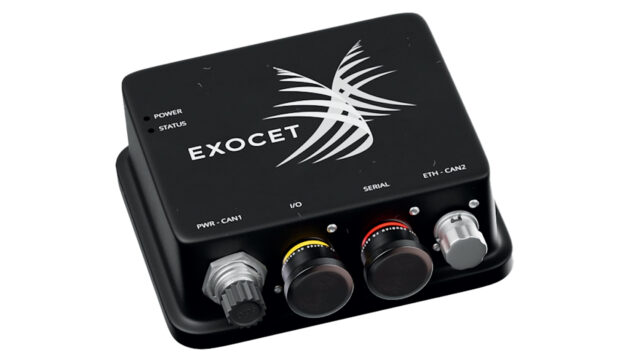
This is exactly what you’d expect of a skilled helmsman, but I’m alone on deck, focusing on sail trim and maintaining a look out, rather than driving, while racing a Class 40 equipped with a B&G H5000 pilot system, plus additional overlays from Pixel sur Mer’s Exocet Essential system. The latter is a multifunction device that includes data logging, sophisticated sensor management and improved autopilot functionality, with both safety and performance overlays.

It’s among a number of top-level pilots that are widely recognised as offering exceptional performance. Legendary French sailor and Route du Rhum winner and record breaker, Loïck Peyron, for instance, told an audience at last year’s Yacht Racing Forum: “The new generation of pilots we have today are absolutely amazing.”

While these systems were originally developed primarily for Class 40s, IMOCA 60s and Ultime trimarans, many of the benefits they bring are equally relevant to cruising yachts, whether large high-performance catamarans or more modest monohulls. Optimising windward performance may not be a high priority for most cruisers, but a great pilot that’s properly set up will make for a more comfortable motion in challenging conditions, with less heel in gusts.

Autopilot reliability and safety

My own experience of using the Exocet Essential and B&G H5000 combination also shows it being very stable with a quartering sea, even when pushing hard with boat speeds of 20 knots, with the pilot retaining excellent control. At these speeds even a small miscalculation of the required rudder angle can create major problems, making it a challenge to develop pilots for fast boats. And of course foiling adds a whole additional dimension.

Historically, pilots were most challenged in the big waves of breezy downwind conditions, with an awkward quartering sea. This, of course, is exactly the weather in which an accidental gybe can be particularly dangerous. In last year’s Rolex Sydney Hobart race, for instance, two crew members on different boats died as the result of a head injury and crush injuries in heavy weather.

While these vessels had full race teams on board and were being hand-steered at the time, a pilot that can steer reliably in these conditions can be a big boost to the safety of a cruising yacht, even if a preventer is properly set up.

A good pilot will also create a more comfortable motion in these conditions, markedly reducing the tendency to corkscrew. However, to be safe, the system must also have bulletproof reliability. More on that later.

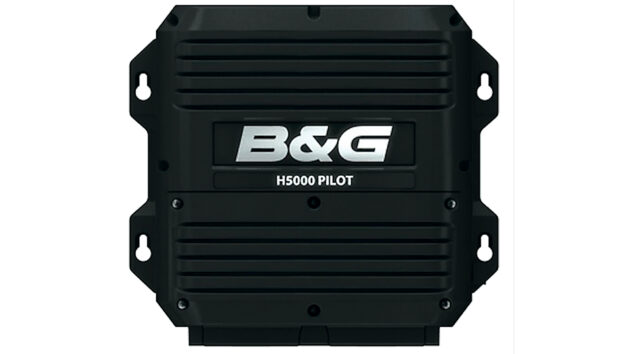
B&G’s H5000 Pilot has years of development expertise behind it

The Exocet’s overlays take the form of an expert system – a type of AI – that sits between the user and the H5000 controller. The B&G unit sees it as a virtual pilot controller, while the expert systems change the requested pilot heading depending on inputs from sensor data, including speed, heel and wind data.

In effect, the pilot computer sees this as the same thing as a human pressing the +/- 1 buttons a few times to help the boat, for instance, to bear away in a gust when broad reaching, even before the heel angle starts to increase. The system is close to achieving the holy grail of steering in a pro-active manner, just like a skilled human helmsman. By contrast, traditional pilots are only reactive – they must wait for a parameter to change and then react to it.

The Exocet’s overlays also allow you to sail to a heel angle, for instance when downwind or blast reaching in exactly the same way as you would sailing a planing dinghy – bearing away in the gusts and coming up in the lulls. It can also steer to a target speed, heading up as much as possible, while trying to stay within the user’s requested heel angle target range, or to a wind angle target, and two overlays can be used simultaneously.

Exocet Essential is Pixel Sur Mer’s entry level data acquisition and navigation system

This may sound complex but the reality is it’s a bit like sail trim and French short-handed racers talk about ‘trimming the pilot’ in much the same way as trimming sails. For fast cruising you can pick settings that are approximately right to achieve great performance, but extra effort in this respect can pay dividends when racing.

Before choosing a system it’s worth being ruthlessly realistic about how much set up you’re actually going to do. I’ve sailed raceboats with complex and expensive electronics that require extensive set up to get decent performance, yet every setting was still on the factory default even after the completion of a Rolex Fastnet Race campaign.

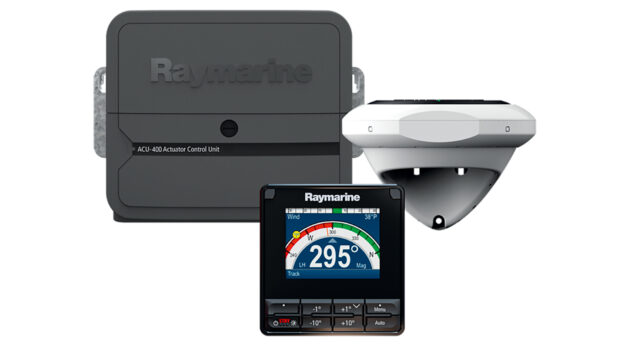
The owners of these boats might therefore have been better served by a more economic plug-and-play system, such as Raymarine’s Evolution series, that uses AI originally developed by then parent company FLIR to improve performance without the need for users to tweak complex settings.

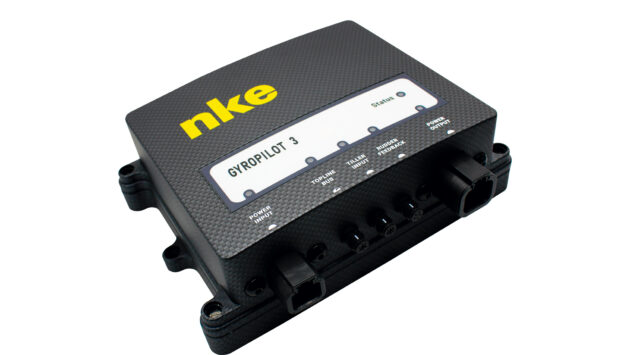
NKE Gyropilot 3 – the French firm is popular with professional racers

Choosing systems to suit

Different manufacturers take different attitudes to the amount of set up required to gain maximum performance from a pilot. Both Raymarine and Garmin, for instance, have opted for a simple approach with automated calibration used wherever possible. Yet this doesn’t necessarily imply a dumbed-down method.

Part of the rationale behind Raymarine’s recently launched RSW SmartWind sensor, for instance, was to improve performance of its Evolution range of pilots, without the need for either a time-consuming set up or a complex user interface.

Both a nine-axis sensor and a processor are built into the SmartWind masthead unit, enabling real-time cleaning of the wind data that takes account of the boat’s roll and pitch, factors that, of course, are greatly magnified aloft. The upwash from the top of the rig is also estimated for different wind angles and strengths. The result is significantly better pilot performance, especially upwind and downwind, when you’re most likely to be using wind modes.

While this is not as accurate as comprehensive calibration achieved over a long period of time by professional race navigators, it represents a huge step forward for everyone else.

“Our aim with this was to give 85-90% of the performance of very high end systems straight out the box,” Raymarine product management director Will Sayer told me.

Raymarine keeps things simple by using a new SmartWind masthead sensor to improve performance of its Evolution range of pilots, aiming to achieve 80% of the performance of high-end systems, without the complexity

B&G’s collaboration with Pixel sur Mer also includes markedly improved course keeping algorithms for the high-end H5000 pilot system.

“The H5000 pilot needs to function across a wide range of boats, from the Sun Fast 30 through IMOCAs to superyachts, as well as more modest cruisers sailing across the Atlantic,” says B&G product director Matt Eeles. After basic calibration procedures, it therefore performs well out of the box across all these boats and for all but the most demanding of users in high echelons of the racing world.

“Working with Pixel sur Mer we were able to test changes to the B&G algorithms one at a time in a controlled environment on a very wide variety of boats, for instance to see what standard settings needed to change to improve the weather helm algorithm,” Eeles adds.

“The process took years before it could be rolled out to the public, via a software update early last year.” This improved functionality is also available to existing H5000 users.

This system therefore gives users the opportunity to use it with a minimum of set up, while also having the benefit of more advanced settings that can be tweaked to improve steering response in a wide range of more testing conditions.

The Madintec pilot system was designed from scratch to make extensive use of AI to boost performance

Features include a recovery mode that quickly corrects for sudden course deviations caused by out of pattern waves. Gust response takes preventative action based on instrument data to hold a more stable course in changeable winds. Thirdly, high-wind response bears the yacht away when wind speed increases while reaching, keeping the boat flatter and driving faster. There are also failsafe algorithms and user configurable hard limits that increase safety factors.

AI simplicity wins

Madintec, another small French company, was formed in 2017 with the express intention of creating the ultimate pilot system, creating an all-new platform from scratch that makes extensive use of AI to boost performance, streamline the user interface and improve sensor calibration.

Yet at the same time, a key principle from the outset was that it had to be simple. “Simple for pro sailors and simple for amateurs,” research engineer Pia Mathias told an audience at the Yacht Racing Forum. “If we look at the Vendée Globe, sometimes skippers haven’t eaten in a few days and they haven’t slept a lot. So a tired skipper has to be able to use our pilots and a new skipper also has to be able to use them.”

The company was founded by veterans of an America’s Cup campaign who saw an opportunity to transfer technologies and methodologies from both the Cup and the aerospace sector into offshore yacht racing and then into more everyday sailing. It has been hugely successful, with the system, for example, chosen by the last two Vendée Globe winners, Charlie Dalin and Yannick Bestaven.

While Madintec originally had Class 40s, IMOCAs and Ultimes in mind, it’s now also gaining traction among short-handed IRC racers and in the cruising world. The first four 33ft Pogo RCs, for instance, are all equipped with Madintec systems. It also worked closely with MODX to develop a fully automated control system for the inflatable wing sails on this extraordinary 70ft catamaran.

Time to hand over?

So, what about the question of whether today’s AI-enhanced performance pilots make for better helmsmen than humans?

While that’s the ultimate aim, and the very best systems are making great strides in that direction, they aren’t there yet. A lot of recent R&D has also been spent on controlling the flight of foiling boats, technology less relevant to the majority of cruising sailors. So, arguably no pilot is yet as good as a skilled and focused human driver, an important point for the crewed offshore racing world – but they can be a lot better than a less skilled and tired crew member on a cruising yacht!


If you enjoyed this….

Yachting World is the world’s leading magazine for bluewater cruisers and offshore sailors. Every month we have inspirational adventures and practical features to help you realise your sailing dreams.

Build your knowledge with a subscription delivered to your door. See our latest offers and save at least 30% off the cover price.

Note: We may earn a commission when you buy through links on our site, at no extra cost to you. This doesn’t affect our editorial independence.


Chat/call The AYB Team
error: