MODX: An electric 70ft catamaran with inflatable wingsails!

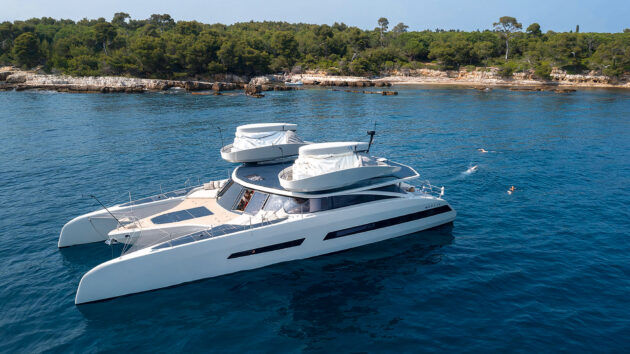
The MODX is a 70ft catamaran with fully automated twin inflatable rotating wingsails set on telescopic retractable masts and powered by electric motors with variable pitch, hydrogenerating propellers.

Every now and again something really different comes along, and this was one of those concepts you don’t think will come to reality. I say that, having spoken to the design team about it years ago, and seen plenty of renderings of what it might look like.

So, the curiosity of such a venture we expected. The fact that our video tour from its launch at the International Multihull Show in May was one of our fastest to reach 100,000 views, less so. Also noteworthy with that video is the sheer amount of largely positive comments supporting the technological development (when you consider that these comments stem from a typically sceptical audience).

Everything about this project is quite fascinating, from the VPLP-designed wave-piercing hulls to the automated power and sail systems. A primary goal for the MODX is to offer zero CO2 emission cruising by utilising completely renewable energies.

The scheme carries plenty of credibility, thanks to design by VPLP and construction by Océan Développement, the yard responsible for the fleet of MOD 70 ocean racing one-design trimarans built in 2008.
Thermoplastic polyurethane wingsails are raised on rotating, telescopic masts. Photo: Ronan Gladu

However, it’s those enormous wingsails which spike the most interest, of course.

Built by Aeroforce, a company set up specifically to develop the technology, these twin AF125s are each 125m2 inflatable wings with auto trim functionality. They’re claimed to be 1.7 times more efficient, safer (no winches/ropes), and create 20% more space aboard than conventional rigs.

Blow up sails

“Powerful and stable wings that can be automated is why we developed Aeroforce,” CEO Jean Guyon told me during the yacht’s premiere in La Grande Motte. “The MODX’s goal was to be energy independent. So we needed a fast boat, but it’s also why there are wingsails – the target was that in 10 knots wind, we should do 10 knots boat speed.”

The telescopic masts are formed of six sections which rotate around bearings at waterline and deck level. The masts are 23m high when fully raised and have a deep reef to reduce the sailplan to 65%. (It’s worth noting that most sailing footage so far shows the yacht in reefed format.)

Sails are inflated to their aerofoil shape – a process that takes just eight minutes. Photo: Ronan Gladu

The wings are housed in huge cradles above the coachroof and take eight minutes to hoist and inflate. Made from thermoplastic polyurethane (TPU), these sails are inflated to a comparatively low pressure of 100 millibar, or around 10 times less pressure than a typical inflatable paddleboard – which allows pumps to be used for inflation rather than compressors.

The wings also have a trailing flap, which works like those of an aeroplane to increase lift by 30-40%, Guyon estimates. He explained how the airfoil shape increases airflow on both sides of the wing, “so pointing is quite good at 40-45° to the apparent wind.”

In terms of performance, the MODX has hit 21.5 knots in 25 knots of wind at 150° to the apparent, or 9.5 knots in 11.5 knots at 46° apparent – which is already very close to the initial target of 10 knots in 10 knots of wind.

The gearbox and rotating chain used at the mast bases allow for 360° rotation of the wings, providing a tangible benefit for spilling wind. Consider how smooth and quiet gybes can be when you can completely open the sails and rotate the masts downwind through the gybe. This brings us to the yacht’s impressive automatic operation.
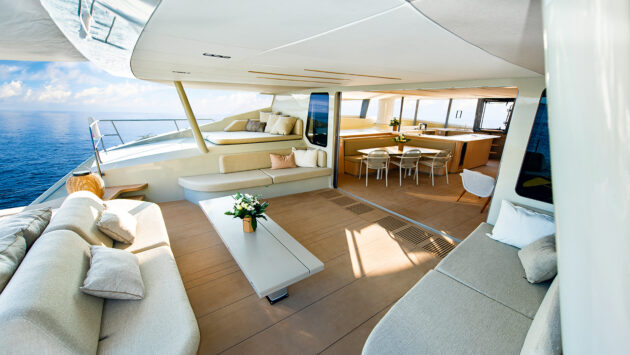
The 70-footer also offers luxurious accommodation. Photo: Martin Viezzer

Auto functionality

The MODX is piloted from a single wheel and internal helm station, adorned with touchscreens. “The project is trying to attract people from power without the complexity of sail,” is how VPLP’s Mathius Maurios explained the concept to me.
“It’s about being on the water without being stressed.” With this in mind, the project team wanted a fully automated sail/wing control system, as easy to use as cruise control.
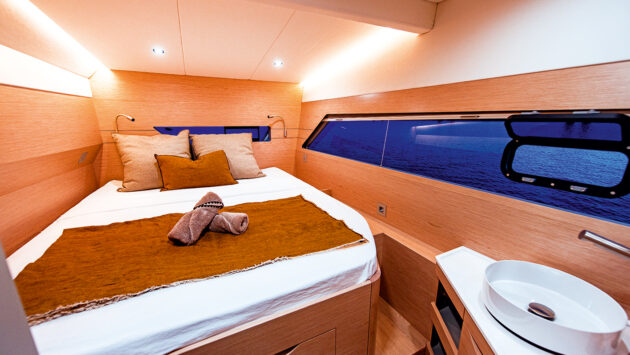
The aft owners cabin is luxurious. Photo: Martin Viezzer

They worked with Madintec to develop a highly sophisticated yet approachable wing, hydro and energy management system.

This French company has developed performance autopilot systems for many of the top IMOCA 60 teams. So when you look at the helm station on the yacht, on one side is the throttle control for the electric engine, and on the other, a more crude, simple throttle lever (which looks like something out of a Thunderbirds rocket).
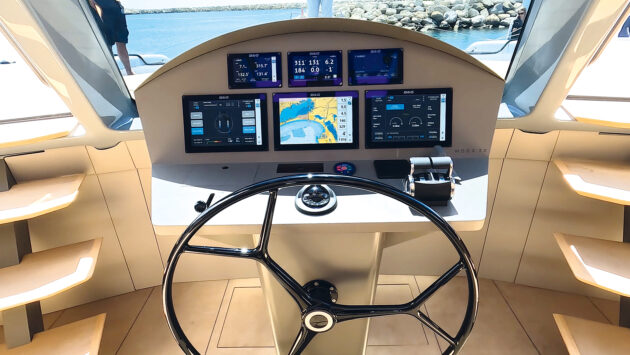
A solo-operated 70ft cat? Helm station has throttles for the electric motors and wind engine. Photo: Chloe Lambelet

So, in terms of piloting this 70ft performance catamaran, once wings are raised, the operator simply pushes the wing throttle lever forward, selecting from 0-100% of potential force. Therefore, it’s not just an auto-driving boat, but one that uses auto-tuned sails too. If you only want 50% of the power available, it’ll release the sails to spill more wind.

Silent sailing, silent power

With no running rigging, the coachroof can be pushed out to maximum beam, creating the largest area possible for solar panels. The MODX has 70m2 of panels, which provide a peak of 15kW, or up to 35% of its electrical energy mix. Although the company is looking into a flybridge alternative to cater to demand, this wide, flat surface on the first boat is also ideal for harvesting rainwater, and there are two 400lt tanks dedicated to this.
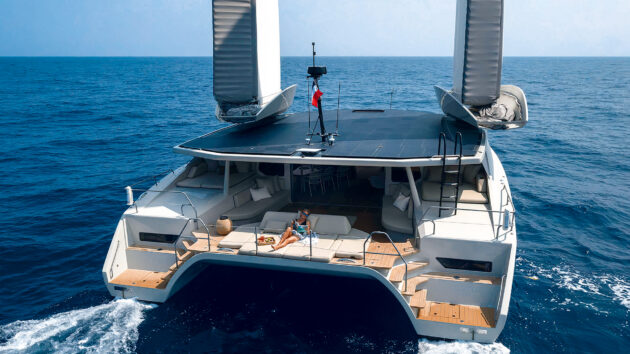
No side decks, engines or tender aft – instead clear transoms and a huge aft leisure cockpit. Photo: Ronan Gladu

At the heart of the electrical system is a 250kWh LFP lithium battery bank – as a comparison a battery in a large electric car is around 90kWh. It’s enough for guests to live aboard for 10 days without sun, wind or engine use, or provides 110 miles motoring range at 5 knots. When sailing, the variable pitch propeller can hydrogenerate power back into the battery bank. So, at 15 knots boat speed, it’s possible to generate 16kWh back into the system.

Unfortunately, what we can’t show you is the nucleus of the MODX system: its technical rooms. I was granted a quick look but not allowed to take photos or video. These are located at the mast bases at the foot of each forward companionway and house the electrical and telescopic mast systems, in a cocoon of carbon fibre with significant bulkheads to help support the latter. Otherwise, the MODX is built in glassfibre, using bio-sourced resin and 40% recycled foam.
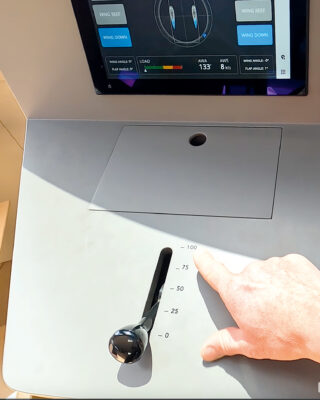
A throttle lever is used to control sail power. “A ‘wing throttle’ is the best way to think about the power of the wing, like an engine throttle,” says Aeroforce’s CEO Jean Guyon. Photo: Yachting World

The rest of the interior in the first boat is suitably luxurious, particularly on the main deck, which offers motoryacht-style comfort, near-surround ocean views, and 135m2 living space in the saloon, fore and aft decks. However, we can’t go into more accommodation detail as it’s a largely customisable space to suit private, charter or ‘expedition’ use.

A MOD Future?

So what is the future for this concept, and what size vessels might the Aeroforce wings be practical for? “The initial design was for 55ft, but we needed more solar to reach the efficiency targets,” Guyon explained. The right balance of solar and boat speed was found at 70ft. He added that doing a 100-footer would be easier than a 55: “I don’t see the potential in less than a 100m2 wingsail size.”

Aeroforce is also looking at the obvious potential of its wings for commercial shipping, as well as for leisure monohulls, where they might provide less heeling moment and more thrust.

MODX specifications

LOA: 21.33m / 70ft 0in
Beam: 10.00m / 32ft 10in
Draught: 2.00m / 6ft 7in
Air draught: 4.60m / 15ft 1in
Wing area: 2 x 125m2 / 2 x 1,345ft2
Displacement: 30,000kg / 66,138lb
Electric motors: 2 x 20kW / 2 x 27hp


If you enjoyed this….

Yachting World is the world’s leading magazine for bluewater cruisers and offshore sailors. Every month we have inspirational adventures and practical features to help you realise your sailing dreams.

Build your knowledge with a subscription delivered to your door. See our latest offers and save at least 30% off the cover price.

Note: We may earn a commission when you buy through links on our site, at no extra cost to you. This doesn’t affect our editorial independence.

‘The crash was a reminder for us all’ – Nikki Henderson

When the pros are caught on camera making mistakes it proves there’s no such thing as a perfect sailor

You probably saw the collision between the Allagrande Mapei Racing and Team Holcim PRB IMOCAs just moments after the start of the Ocean Race Europe. In the way spectacular disasters are, it was as harrowing as it was addictive to watch. The ease at which Holcim’s foil cut through Allagrande’s headsail cloth was sickeningly impressive, and it’s lucky no one was hurt. But it was also proof of how remarkable these boats are.

The crash was a hearty reminder for us all: mistakes happen, even to the most skilled sailors. If you’re human, you make mistakes, especially in sailing. We need high-profile moments like this to change the culture around mistakes and to remind us that errors don’t make you a bad sailor.

There’s a story many new sailors tell themselves: “When I get good enough at sailing, I won’t mess up anymore.” Perfection feels like the goal, but that’s a myth: perfection is unachievable.

The reality is that mistakes are inevitable. Just consider all the factors that go hand-in-hand with sailing: fatigue, stress, appetite for risk, cognitive overload. Then combine it with the context of changeable weather, unpredictable competitors and high stakes decisions. It’s ludicrous to think otherwise.

I believe we all get allocated the same number of mistakes in life. They just scale relative to your environment and abilities.

Beginner sailors make ‘rookie’ mistakes like tying fenders wrong and dropping them overboard or putting up the wrong headsail.

Intermediate sailors make bolder mistakes, like reefing too late or making sloppy nav calls, usually just when they need a reminder to stay humble.

There was also a crash in Leg 7 of the last Ocean Race

Pros make high speed, high stakes mistakes like aggressive start line tactics or split-second miscalculations. What changes as you progress isn’t the quantity of mistakes you make, it’s the type of mistakes. And while a crash in the Ocean Race might seem bigger than a poorly tied knot, I’ve seen beginners suffer near-panic over small errors. How awful a mistake feels has more to do with you than the slip-up itself.

I hate making mistakes. I hate looking silly or messing up, or worse: being blamed. It probably stems from a fear of rejection. It’s something I have to actively work on.

Mistakes are part of learning and avoiding them means avoiding improving. And the more we fear mistakes the more likely we are to make them. Just put someone under pressure and watch them tie a knot while shouting the oh-so-tempting “hurry up” and you’ll see their hands shake, their brain fog over and voila, it will be tied wrong.

When mistakes happen, what matters most is how you manage them. My mother’s voice still rings in my ears: “I don’t care who started it. Just sort it.” She was talking to my brothers and younger self, but it’s just as relevant at sea. If mistakes are inevitable and we all suffer the same amount, then worrying about blame in the moment is useless. Just look at Kiel: both teams immediately set about repairing their boats to make the next leg. The protest will be resolved later, but the priority was getting back in the race.

Article continues below…

As the sun slipped below the horizon, so did the noise of the day. The thermal wind softened, the engine…

Our defences have run out: social media has well and truly infiltrated our precious, antiquated sailing world. It’s terrifying to…

On the day the Kiel crash dominated my social news feed, I was helping friends handle a mini crisis of their own. One crew member’s passport had been packed in the wrong bag and was halfway to Hamburg on a Boeing 777. If we’d wasted time focusing on whose fault it was, we’d have missed the window to get the passport on the return flight. But we let it go, jumped into action, and two generous strangers ferried it back across the Atlantic just in time for departure. Faith in humanity, restored.

So, if you want to help make sailing more welcoming for us all, leave the blame behind. If you, or someone else makes a mistake, focus first on sorting out the problem then, second, reduce the chance of it happening again by analysing, learning and implementing better systems.

So, thank you Holcim PRB, Allagrande Mapei, and the Ocean Race team for giving us a real-life example of elite sailors learning from, not hiding from, their errors.

The goal isn’t to eliminate mistakes; it’s to handle them well. Sure, the crash was expensive, dangerous and costly in the moment. But maybe it will save others from similar fates – not by avoiding mistakes entirely, but by avoiding the catastrophic aftermath that comes when errors are buried instead of addressed.


If you enjoyed this….

Yachting World is the world’s leading magazine for bluewater cruisers and offshore sailors. Every month we have inspirational adventures and practical features to help you realise your sailing dreams.

Build your knowledge with a subscription delivered to your door. See our latest offers and save at least 30% off the cover price.

Note: We may earn a commission when you buy through links on our site, at no extra cost to you. This doesn’t affect our editorial independence.

Contest Yachts’ five-star line-up for the three premier autumn shows

Contest Yachts, long celebrated for its deep family values and hands-on craftsmanship, will have a compelling presence at this autumn’s boat shows across Europe and the USA.

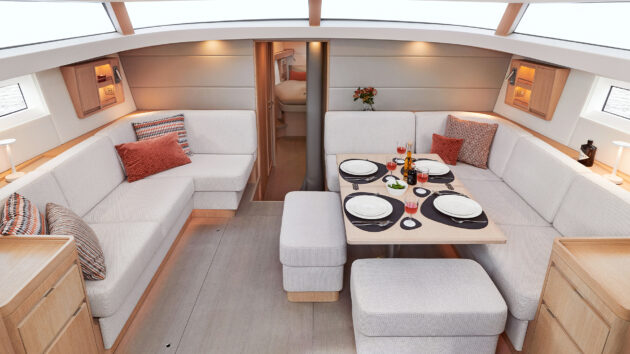
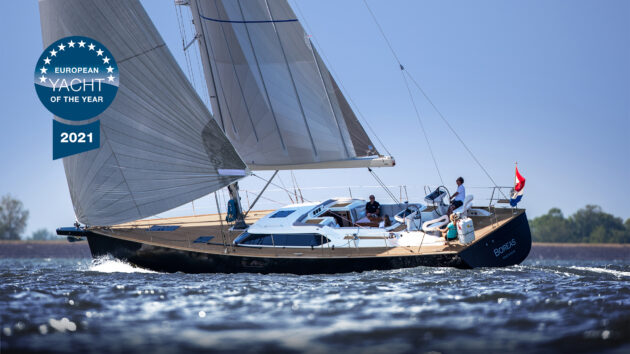
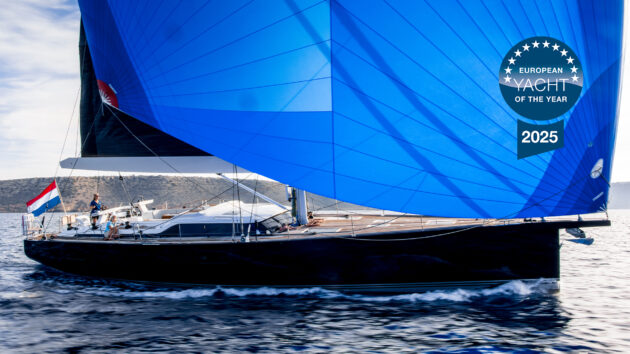
The Dutch semi-custom yard will bring four of its most storied models to three key boat shows. At the Cannes Yachting Festival, visitors will find the European Yacht of the Year 2025-winning Contest 63CS, alongside smaller sister and equally intriguing Contest 49CS. In Southampton, the multi-awarded Contest 55CS returns, while across the Atlantic at the Annapolis Sailboat Show, the Contest 50CS makes its US debut while participating in the Cruising World Boat of the Year 2026 programme which is judged during the show.

Cannes Yachting Festival: Contest 63CS & 49CS

From superyacht ideals to family cruising

At this year’s Cannes Yachting Festival (9-14 September), Contest Yachts’ headline model will be the Contest 63CS, which since announced as the winner of the European Yacht of the Year 2025 – luxury category, continues to draw consistent media praise. Designed by judel/vrolijk & co with interiors by superyacht stars Wetzels Brown, the 19-metre luxury cruiser clearly impressed the award judges. Features that particularly stood out included this yacht’s innovative, transformable aft social deck and the pair of mirror-image VIP guest suites forward of the saloon. This is a very unusual layout at this length and one that sets the yacht apart.

The design’s performance and bluewater pedigree have also been widely praised. Reviewers highlight the 63CS’s ease of handling and effortless performance in even the lightest winds, supported by high-spec systems including electric winches and hydraulic furlers. Below decks, the tranquil ambiance is a hallmark of a Contest yacht, while expansive coachroof glazing delivers superb natural light. As one reviewer put it, “Lusso allo stato puro… naviga con una leggerezza che non fa pensare a un peso… pure luxury sailing with lightness that belies its weight”.

The Contest 63CS

Yachting World’s test team also praised the yacht’s “superyacht-level finish” and smartly thought-through ergonomics revealed at the 63CS’s initial Cannes debut last year. This momentum is amplified by the yard’s rich heritage, as Yachting World’s test editor Toby Hodges observed, “Contest Yachts is one of the largest and oldest family-run yards in the world, and conducts the whole build process on site – a yard with a rich past and a promising future.”

Such words underscore that the 63CS isn’t just a design milestone – it is the culmination of 65 years of craftsmanship, innovation, and bluewater leadership.

Complementing the 63CS at Cannes will be the Contest 49CS, the yard’s first model in the 50-foot sector spinning the cabin arrangement to feature twin aft cabins and a forward owner’s suite, making it equally attractive for family voyaging or sailing with friends. A particular strength of the 49CS’s layout is that Contest has retained its hallmark dual-cockpit style with a spacious aft deck, generous lounging area, tender garage, and fold-down bathing platform – all while preserving the twin-helm’s secure position forward, a defining Contest trait.

Built with the same high-spec composite construction and Lloyd’s Register certification as its larger sister, the 49CS delivers exceptional volume and ergonomics for its class, a superb family cruiser with elegant detailing and serious performance credentials.

Contest 49CS

Southampton International Boat Show: Contest 55CS

Award winning design returns to UK waters

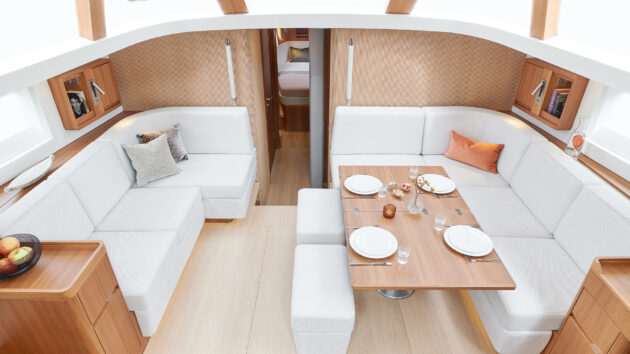
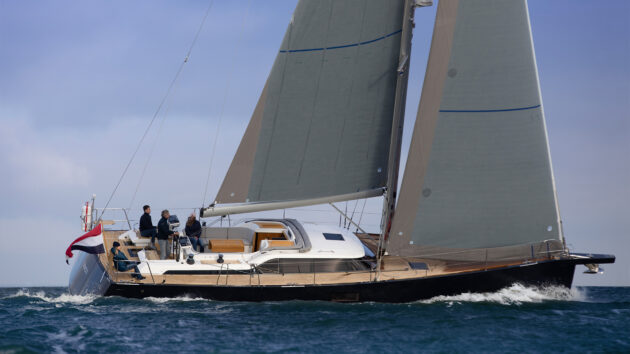
At the Southampton International Boat Show (19–28 September), Contest Yachts will present the Contest 55CS, a bluewater cruiser that has already earned significant accolades – including the European Yacht of the Year, and British Yachting Awards, again in the luxury performance category. At 17 metres, the 55CS offers the same power, performance, and build ethos synonymous with Contest’s evolved lineage.

Inside the Contest 55CS

Designed by judel/vrolijk & co and crafted to exacting Lloyd’s Register standards, the 55CS blends sumptuous styling, exceptional ergonomics, and robust sea-going ability. Inside, light-filled cabins with expansive hull windows and eyeline wraparound glazing are paired with Wetzels Brown’s thoughtful interior styling to deliver effective, practical opulence. The yacht also boasts intuitive control systems and meticulous soundproofing for a markedly quiet onboard experience, even under way. It’s a hallmark of the yard’s refinement: a delight below decks – restful, calm, with only the faint fizz of the passing seas.

Contest also emphasises owner operation as a cornerstone of its design. High-specification soft- and hard-ware run throughout, with powered systems at fingertip reach, retractable bow thrusters, self-furling gear, and automated conveniences all ensuring ease, confidence, and simplified maintenance. It makes for a superyacht-standard package, delivered in a size perfect for capable owner-sailors.

The Contest 55CS

Annapolis Sailboat Show: USA Premiere of the Contest 50CS

A new generation dual centre cockpit contender

In the USA, the flagship arrival will be the Contest 50CS, making her American debut during the Annapolis Sailboat Show, where she’s also an invitee in the prestigious Cruising World Boat of the Year 2026 programme.

This latest-generation 50-footer revitalises the centre-cockpit concept with superyacht-inspired volume, assured performance – both upwind and downwind in all conditions, and with low angles of heel – and a remarkable ease of handling that allows even for confident single-handed sailing.

Below on the Contest 50CS

Judel/vrolijk’s modern hull form pairs with Wetzels Brown’s light-filled interiors, delivering a yacht that is as elegant as it is seaworthy. A generous aft master suite, a welcoming forward guest cabin, and the option of a third cabin reflect the yacht’s balance of luxury and practicality. On deck, twin helms, a clean walkthrough cockpit, protective curved-for-comfort coamings, and power-assisted sail handling all ensure safety and control. Below, carefully engineered composite structures and extensive noise-damping measures create a calm, near-silent motion under way.

Every element is conceived for long-range comfort and bluewater reliability, from the hydraulic transom platform to the neatly integrated stowage solutions throughout. The result is a contemporary cruiser that brings Contest’s hallmark craftsmanship and Lloyd’s Register-certified build quality to a size as manageable for a couple as it is welcoming for family and friends.

Contest 50CS

A rich past, a promising future

So, the Autumn 2025 Show Season sees Contest Yachts confidently presenting its latest models on the world stage, bringing together a fleet that bridges heritage with forward-looking design. The 63CS demonstrates the yard’s mastery of superyacht finish in a manageable length. The 49CS introduces a fresh family-friendly platform at the heart of the range. The 55CS continues to embody award-winning performance and practicality. And the 50CS, with its US premiere, signals Contest’s increasing presence in North America.

As Yachting World’s Toby Hodges observed when testing the 63CS: “Contest Yachts is a yard with a rich past and a promising future.” This autumn that future is firmly on display with a show line-up that promises to inspire sailors on both sides of the Atlantic.

‘Teams don’t see The Ocean Race Europe as a walk in the park’ – Matt Sheahan

It might be a different challenge to the Vendée Globe, but The Ocean Race Europe still brings high-intensity racing to the ocean-going IMOCAs class

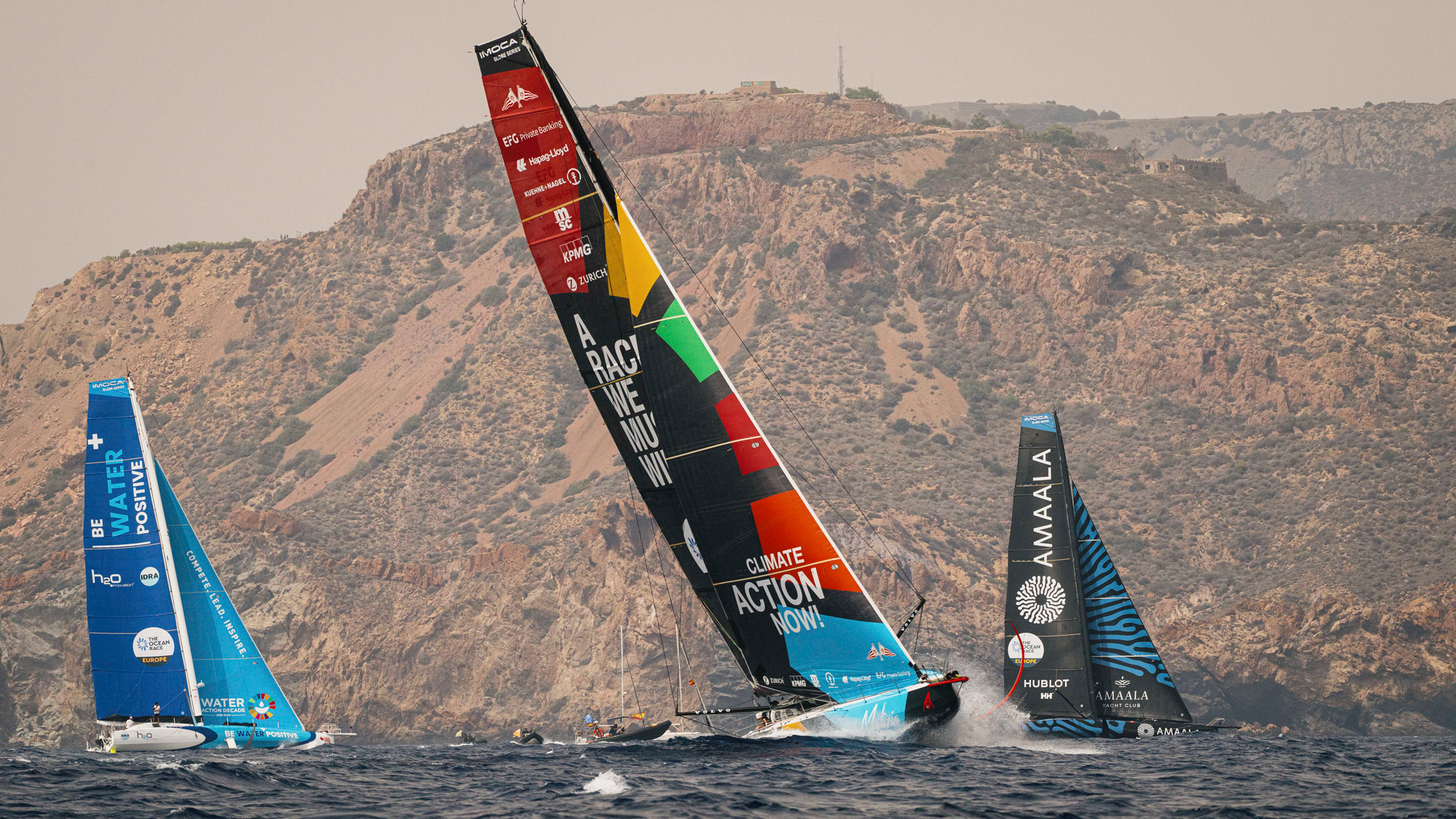
Given what the IMOCA 60 class was designed for – and the way in which blasting around the world non-stop, alone, on foils in just under 65 days grabbed everyone’s attention last winter with the Vendée Globe – we could be forgiven for thinking that a six-leg, fully crewed, stopping service around Europe is a walk in the park for the world’s top sailors and their 60ft rocket ships.

You might not be surprised to hear they don’t seem to see it like that. After all, what’s the point in talking down an event that many of them have been talking up for months in the boardrooms of potential commercial backers?

I spent a bit of time with the skippers and crews on board their boats and on the dock ahead of the start of The Ocean Race Europe in Kiel, and it’s quite clear they mean it when they say that the 4,500-mile, six-week race would be extremely tough.

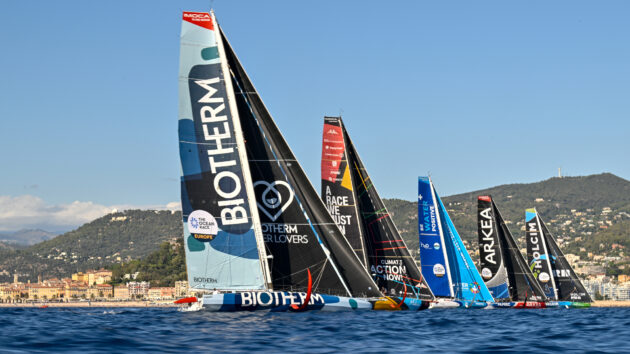
Sam Goodchild, who is sailing aboard Biotherm, looked me straight in the eye and said: “It’s not going to be easier than the Vendée Globe that’s for sure.”

Biotherm skipper Paul Meilhat, who finished 5th in the last race around the world, and who sailed Biotherm fully crewed in the 2022/23 Ocean Race told me that, while he had recuperated physically from his recent lap of the planet, he hadn’t fully recovered from the project mentally and that this race around Europe would give him, ‘the kind of slap in the face that I need to get back on track!’

Photo: Jean-Lous Carli / The Ocean Race Europe 2025.

Both of them talked of the intensity of the race and the focus it requires – particularly the complexity of a course that weaves itself around sand banks, rocks and wind farms to exclusion zones, shipping lanes and general traffic. They talked of the complex weather, the tides and, of course, their competitors. The crews may have barely discussed a watch system, given that there’s so little opportunity to operate one if you’re going to stay ahead of the pack.

The longer legs in this race from Kiel, Germany, to Boka Bay in Montenegro, each take around four days, around the time that the rest of us might take to do the Fastnet Race. But in their case, they do five of them back-to-back with just three days at best between each race. Each team is also limited to just five shore crew, which means the race crew will have to muck in at the stopovers if there is (and there will be) anything to fix.

The fact is that even though The Ocean Race Europe doesn’t really bill it like this, the crews see this as a very different and intense race for this class, something akin to the Figaro, or perhaps even a bigger version of the Tour de France à la voile of the early 2000s when it was raced in Mumm 30s.

So, whether you were talking to Yoann Richomme, Brian Thompson, Boris Herrmann, Cole Brauer, Pip Hare or Alan Roura, they all said much the same. They also said they were looking forward to learning from each other.

“When you sail on your own all the time you do tend to stick with your way of doing things,” Goodchild pointed out. “But working with others who have been your arch competitors provides a great opportunity to try out different techniques.”

Article continues below…

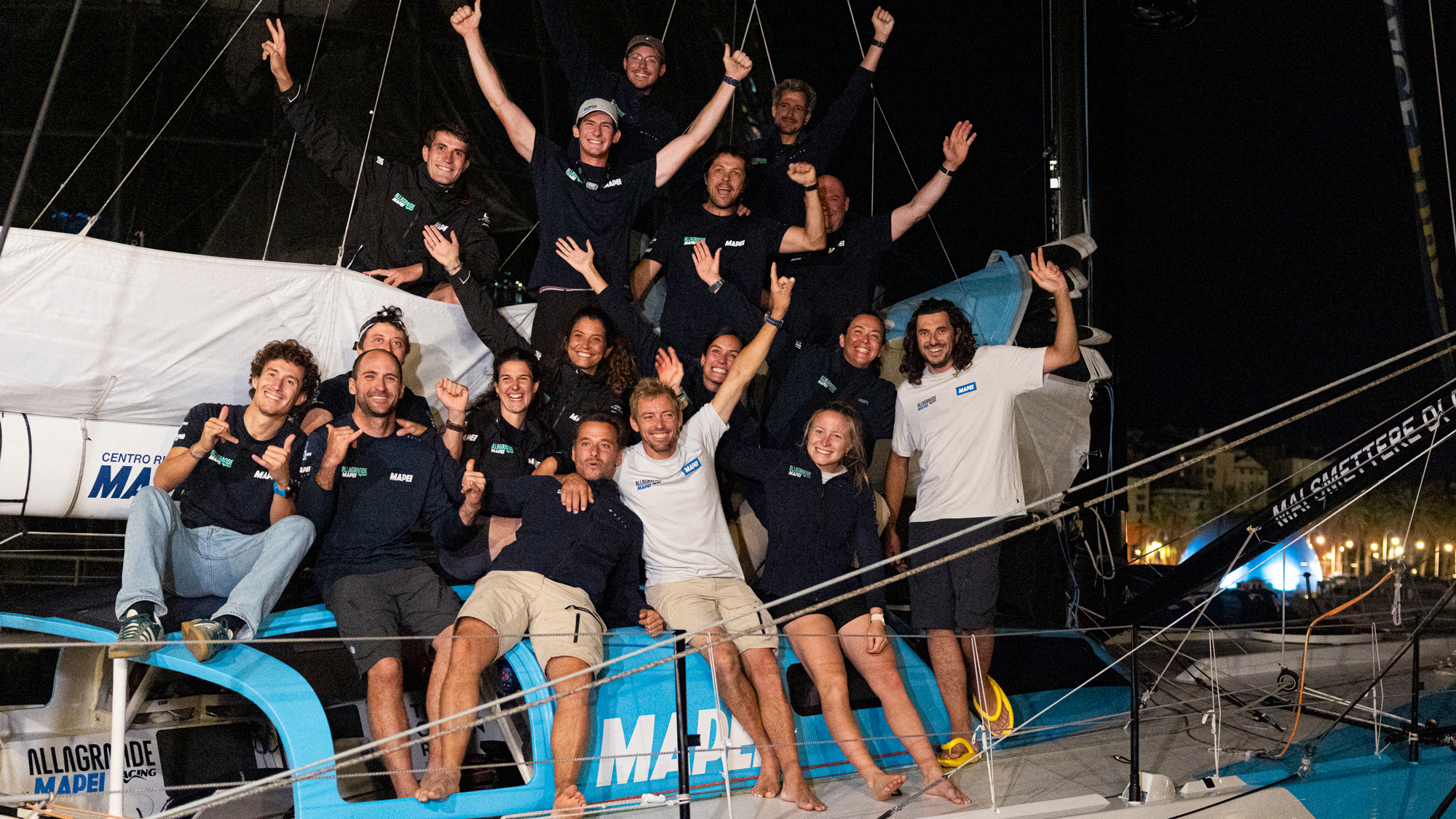
Ambrogio Beccaria’s team Allagrande Mapei Racing made a triumphant finish to The Ocean Race Europe Leg 4 as they arrived…

In the latest from the Ocean Race Europe Leg 3, Biotherm is still defending its perfect streak from Leg 1…

And therein lies a hint to something else that’s going on in this class. The ability to experiment, test, develop and refine the IMOCAs by pushing them harder with a full crew than you would alone is providing a form of accelerated learning in some cases.

The last around-the-world Ocean Race ended up attracting a lot of interest from the offshore rock stars as they started to see that some of their arch-rivals were collecting valuable data on the long ocean legs that might be useful in their solo campaigns. For some, that resource remains in their minds and they’re using the wide variety of races now available for this class as a means of learning more.

With 5-10 new boats expected for the next Vendée – several in build and price tags of up to €6m apiece – there’s no shortage of focus on winning the ultimate solo prize.

But the newfound intensity in crewed IMOCA racing can also come at a price, as Holcim PRB and Allagrande Mapei Racing discovered less than a mile off the start line in Kiel when a serious collision forced both of them out of the leg.

Dramatic as it looked, the large hole in the side of Holcim wasn’t the biggest issue, instead it was time. Fixing this kind of damage can be done, but when the round Europe schedule is as relentless as this one, a crisis like this can be a huge blow to a campaign.

No wonder the teams don’t see this race as a walk in the park.


If you enjoyed this….

Yachting World is the world’s leading magazine for bluewater cruisers and offshore sailors. Every month we have inspirational adventures and practical features to help you realise your sailing dreams.

Build your knowledge with a subscription delivered to your door. See our latest offers and save at least 30% off the cover price.

Note: We may earn a commission when you buy through links on our site, at no extra cost to you. This doesn’t affect our editorial independence.

Chat/call The AYB Team
error: