10 essential multihull sailing skills you need to know

Nikki Henderson on the essential multihull sailing skills you shouldn’t set off without for smooth catamaran or trimaran cruising

The plan is simple: buy a boat and seek out your best life. You’ve decided you want a multihull, for the space and stability that offers.

Your other key requirements are comfort – a yacht you can live aboard for months – and a multihull that’s bluewater capable so you can explore wild remote places. It has to be safe, of course. And spacious enough for you, your partner, maybe your kids (and perhaps someone to help look after them sometimes), or a few friends and family. After all, adventures are better shared.

Bonus items? If the budget allows – performance, please! A fast boat means less time at sea (critical for keeping the non-sailors happy). Faster means more fun, but also the faster you sail the more flexibility you have for weather routing. So speed equals safety.

If this all sounds familiar, that’s because many Yachting World readers dream of the same thing: a bluewater catamaran, powering through the miles, and the freedom of an endless horizon.

Every year, I work with hundreds of people chasing this dream. And wow, it’s a big project! Most begin with hours upon hours, if not weeks, lost to YouTube and online reviews, comparing boat brands. Once committed, the number of decisions to make and to-do list items explodes.

What modifications or custom options will you want? Do you want gas or all-electric? How many cabins do you need, and what layout suits you best? What sails do you need? Who to make them? Then there’s electronics, spares, tools, toys, logistics… and how to leave behind your land life.

Buried in logistics and yard work, cruisers often fall into a common trap: time and time again they forget the sailing element.

Many new catamaran owners are experienced monohull sailors but new to multihulls. Others charter in the Med a few times a year but have never owned their own boat. Some haven’t sailed in years – kids and work got in the way. Some, incredibly, are total beginners.

Article continues below…

What are the best bluewater multihulls for long term cruising? The one you own, or the one you can afford…

There are many categories in the European Yacht of the Year awards, from the best luxury yachts and performance yachts to the best yachts for families and evet…

So when the boat finally arrives or the jobs list is finished in the yard, most owners are exhausted and over-excited. Their sailing skills are rusty. But, at that point, taking the time to polish up their boat handling is not what they want to do. Understandably, they want to slip lines and go.

The problem is that a lack of skill and confidence can lead to a bumpy first couple of years cruising. The best case scenario – if they’re lucky – is that only the boat gets bruised. I’ve seen many boats listed for sale within two years.

Two things matter most to the success of your bluewater experience:

  • The brand and model of catamaran you buy
  • Your sailing and cruising skills

Your skill and confidence will make or break your experience – and your crew’s too. Here are the 10 top skills to polish before casting off.
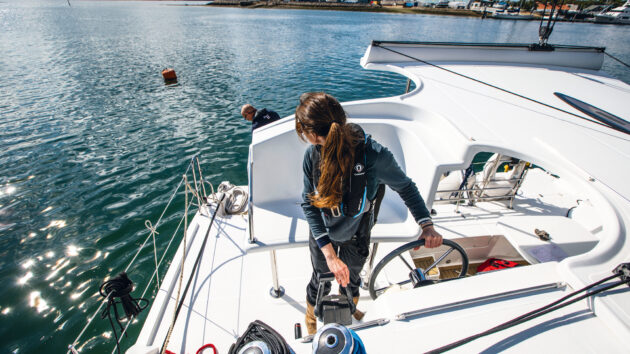
Leaving or manoeuvring in a marina – and dealing with twin engines – is likely to be your first test of handling skills with your new catamaran. Photo: Richard Langdon

Docking a catamaran with Twin Engines

Leaving the marina is going to be the unavoidable first step. The departure sets the tone. Nail it, and there’ll be a good feeling in the air.

Twin engines take some getting used to. First, forget your rudders: lock the helm straight and steer with the engines. Famously, cats can spin on the spot. But it rarely turns out quite as advertised… high topsides, no keel, and light bows mean your ability to pivot is often negated by windage and drift.

Once you figure out how to use the limitations of a cat to your advantage you’ll love the double engines. Practice is key.

Catamaran docking tips

  • Stern to wind is your mantra. Keeping the stern facing the wind makes the boat more stable and easier to control.
  • Park in reverse. Stay stern to the wind, and you have better visibility and comms with the aft line handler.
  • Skip the ‘spin’. Where possible, use a 3/5/7-point turn with one engine at a time. It’s simpler, less confusing and thus less risk-prone. And you can keep the boat to windward of the tight space within your turn.
  • Use one hand. Traditionally, driving multihulls was taught with two hands: left hand left throttle; right hand right throttle. Change this to one hand. Then you can move around, twist your torso, see, communicate and park successfully.
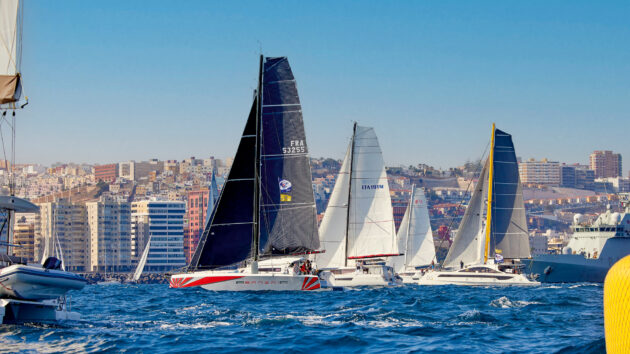
Multihulls are becoming increasingly popular for sailors taking on an Atlantic challenge – here setting off on the Atlantic Rally for Cruisers (ARC). Photo: James Mitchell/WCC

Wind angles and routing

Factory polars can be shocking. “50° to windward?! How will I ever get upwind anywhere?” you wonder. Well… yes… catamarans are reaching machines. They don’t point well. Daggerboards help a lot with upwind performance. But even then, crack off 10° and they fly.

Don’t blame your tools. Learn how to use them. So how to best leverage this?

Sail more miles, faster. Cracked off = big speed gains. Sometimes you can still reach a windward destination faster than a monohull of similar length by using this technique.

Wait it out. If a shift is coming in the next few days, consider delaying your departure. Then enjoy a fast few hours of downwind sailing, rather than the 10 hours slog you initially signed up for.

Don’t pinch – it doesn’t work. Accept your angles and see if you can outsmart your own plan. If you do ever see a cat pinching, don’t be fooled. They will be using the engine for assistance.
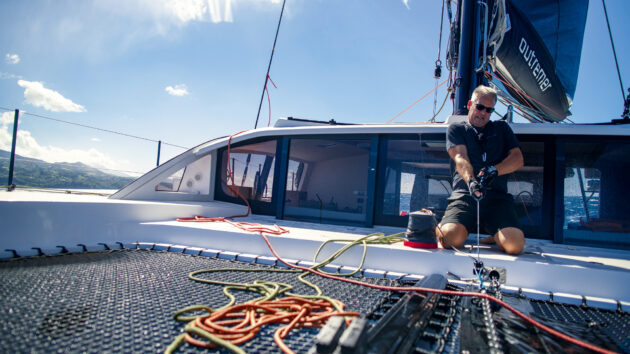
Multihulls are weight sensitive so try to keep heavy items central and low. Leading anchor chain aft away from the bows is prudent. Photo: GLY

Weight management

Cats are wider, roomier, and generally have more space for more stuff (much of which you probably don’t need). But they are also lighter, and more weight sensitive. All this means there is a lot to consider when it comes to stowage.
If you are a monohull sailor, be prepared to pay just as much, if not more attention to how much and where you add extra weight on board.

Catamarans are typically lighter displacement than a monohull of equivalent length, and so extra weight on board will have a greater impact. And, unlike a monohull which relies on its keel for stability, a catamaran relies on its beam. Therefore, loading the catamaran with weight aloft, or not distributing it evenly across both hulls, will make it more prone to heeling and reduce its stability.

What to do

  • Live minimally. Be ruthless about what comes aboard. Once ‘stuff’ (the usual culprits are extra kitchen equipment, doubled-up tools and spares, shoes you never wear, water toys you never use) comes aboard, you will feel a sense of ‘loss’ to take it off. Save yourself the grief, and never let it on.
  • Keep the ends light. I know they are roomy and no one sleeps there. But they are empty for a reason! Weight needs to be central, and low. Consider storing the outboard motor off the tender and use bow lockers for light gear only.
  • Balance port and starboard. One hull shouldn’t carry your whole life. Check from astern on a calm day that your boat isn’t listing.
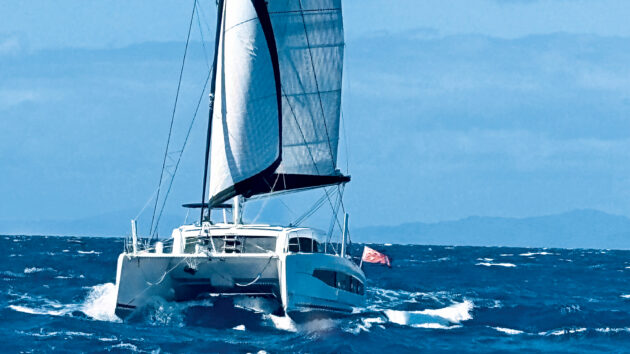
Reefing early is vitally important with a catamaran. Photo: Marianne Urth

Reefing a multihull

Cats don’t spill any power via heeling. They just power up, until they flip. And that is why reefing is key. Reef proactively. Set strict wind speed reefing thresholds (lots of manufacturers recommend these).

But don’t be afraid to err on the more cautious side, as the guidelines rarely take into account sea state.

Multihull reefing tips

  • Topping lift! No vang means the boom drops hard onto the roof without it.
  • Mainsails don’t drop easily. There is a lot of friction due to full battens compressing mast cars, and probably a 2:1 halyard. Consider using downhauls on the luff or upgrading mast cars to ones with roller bearings and using the reefing line to coax the sail down. If all else fails, you can change course upwind but be cautious of the increased apparent wind when you do that.
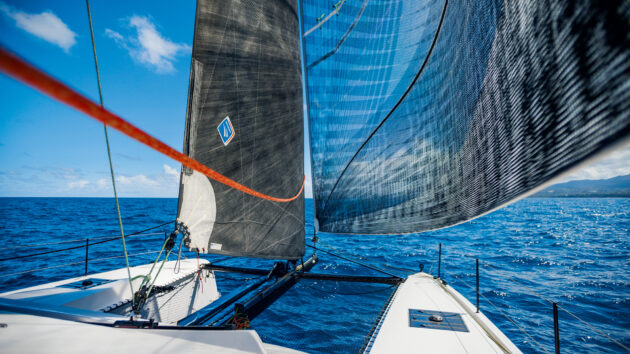
Keeping weight out of the ends is key for sailing performance. Photo: GLY

Depowering a multihull

As aforementioned, gusts don’t spill power on a cat – they load it up. Multihulls can take a lot, but the line between everything being fine and not fine is sudden. You need a fast, simple depowering setup in case of any unexpected gusts or squalls.

The previous advice was to reef early – but we aren’t always good at that. So you need a plan if you get caught out and miss the window of opportunity to reef.

Multihull depowering tips

  • Active sheets. Keep these on winches with the clutches open – always the mainsheet and headsail/spinnaker sheet.
  • Traveller dump. The windward traveller line should also be ready to dump. In a gust, this can be your first move because it’s in the cockpit where you also are likely to be.
  • Bear away. Go for a quick bear away as soon as you’ve depowered the sails to reduce the apparent wind. Practice hand-steering this.
  • Turn downwind fast. Quickly straighten the helm the moment you don’t feel the wind on your windward cheek.
  • Daggerboards. Keep the leeward daggerboard line on a winch ready to quickly raise it to avoid tripping.
  • Depowering. For kites and gennakers, set up quick-release tack systems for instant depowering.
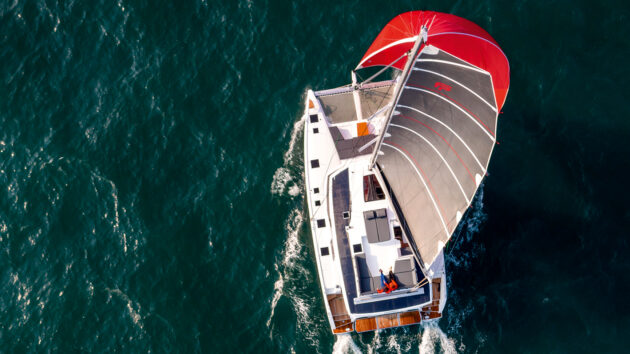
Catamaran sailing is all about the fun –especially downwind, when properly set up. Photo: Jean-Marie Liot

Downwind sails

Cats sail downwind like a dream, so it’s time to embrace that. You’ll be especially thankful for your and your crew’s proficiency with the spinnaker or Code 0 when the winds soften and you have a long ocean passage ahead of you.

Any monohull sailors might underestimate the gains to be made by flying downwind sails. But a few knots can make a big difference over 3,000 miles. Anyway, you are out of excuses! Cats are stable, the bow is safe – and with its big soft nets, it’s even kind to your knees. There’s no justification for not going up there and giving this a go.

Downwind catamaran tips

  • Practice the drop. If you know you can get it down, you overcome the fear of putting it up. This might include using socks, furlers, or a traditional drop to douse the offwind sails. Nail them all!
  • Optimise your systems. Make hoisting, flying and dropping these intimidating sails easier – reroute lines if needed, add Martin Breakers (a quick-trip shackle to release tack line under load) and use electric winches if that helps smooth
    the routine.
  • Learn the angles. The more you understand about what wind strengths and angles your sails love, the more likely you’ll be to fly them. Get as much data as possible, or a sail crossover chart from your sailmaker. And also keep a good log and note your own numbers.
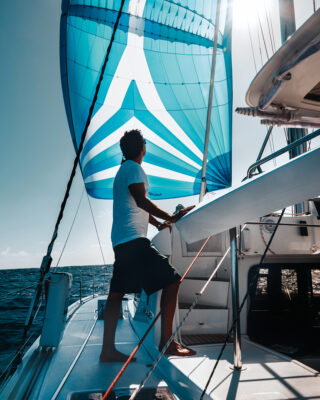
No excuses to go without a kite. Photo: Saskia Stainer-Hutchins

Feedback cues

We’ve all been there. You go off watch with the boat sailing peacefully in 10-15 knots. And you wake up having fallen out of bed, the boat heeled over hard, in 20 knots upwind. You will now reminisce on those days with fondness. As a catamaran sailor, you are going to have to master the art of subtlety. Specifically, interpreting less obvious feedback that the boat is overpowered or underpowered.

Tips for tuning in

  • Use the instruments. But don’t use them in isolation. Boat speed and wind speed tell you a lot and it’s critical to respond to them with reefing (see point No4). However, you can also sense a few degrees of heel, a change in acceleration, or a shift in pressure with your body. The less reliant you are on instruments and the more intuitive your relationship is with the boat, the safer you will be.
  • Use your hearing! Listen for slamming, rig hum, and the frequency of the wave slap.
  • Log what you ‘feel’. Log regularly and include wider information so you can look back and compare. For example, if a few weeks ago you were happily eating dinner with no reefs in the main, what’s different this time? The sea state? Your fatigue? Intuition?
  • Power down early. Comfort trumps speed on cruising boats 99% of the time (which can be hard to adapt to for successful, driven people). But remember the dream – it’s usually a version of ‘slowing down’.
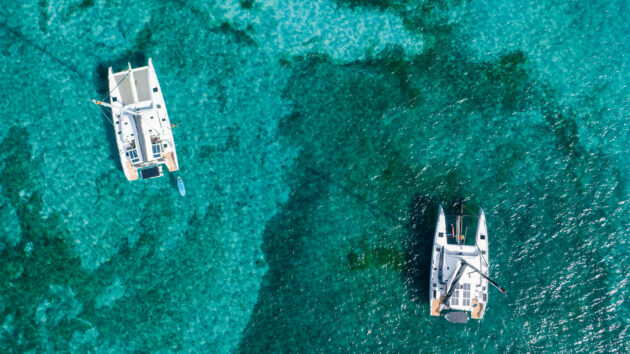
Living the bluewater dream, anchored in an idyllic spot – and catamarans can drop the hook in relatively shallow water. Photo: Robin Christol/GLY

Manoeuvres

Two hulls change things when it comes to manoeuvres: tacking is slow, gybing is violent. You need to get comfortable with it all.

It’s not uncommon to find catamaran sailors who avoid manoeuvres at night. That’s great in theory – until you sail into a wind hole, or want to avoid a squall, or need to miss a cargo ship. Really every bluewater sailor needs to know how to complete manoeuvres in all conditions, at any time of day.

Upwind Manoeuvres

Build up speed before the tack and use it to carry you through. Remember, angles are wider and the turn may well be more than 100°.
If you have them, and they aren’t already down, drop both daggerboards to the same level. It gives you some grip during the turn.
Back the jib through the tack if needed (unless it’s self-tacking, in which case get creative with a handybilly or extra control line).

Downwind Manoeuvres

With a square top, big roach and full battened mainsail, gybing can be exciting. The main needs a lot of control through the gybe. Centre the traveller and make sure it’s locked off on both sides, tighten up the mainsheet, gybe – then control the sheet to dampen the slam when it flips to the other tack.
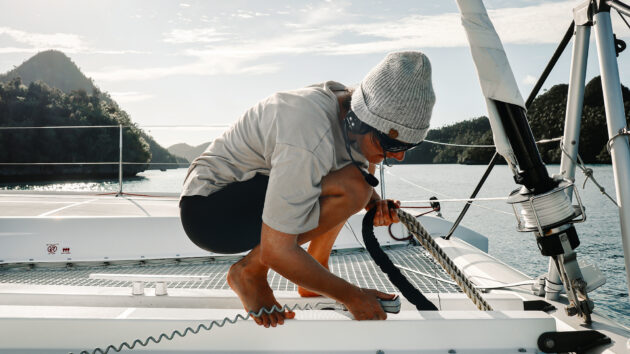
A remote-controlled windlass will be a big help when retrieving and viewing your anchor tackle, while headsets help maintain communication with the helm. Photo: Saskia Stainer-Hutchins

Catamaran anchoring

Most cruisers are at anchor about 80% of the time, even if they are ‘sailing around the world’! It’s a critical skill, and a core element of living the dream.

But in order to spend your days swimming off the back of the boat or enjoying serene sunset cocktails on the bow – and to comfortably sleep, make repairs, and live on the hook – you need to be able to anchor confidently, reliably and securely.
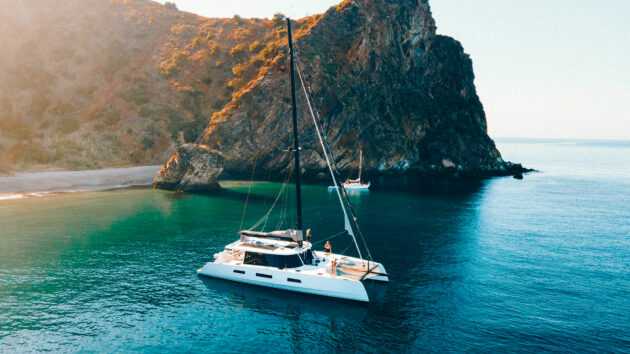
Making sure the hook is properly set will ensure a more relaxing time in that idyllic anchorage. Photo: Kinetic Catamarans

Catamaran anchoring skills

  • Set it properly. Use 3-7 times the depth. Reverse hard on it (1,500-2,000rpm) – better to drag and find out it’s not holding now, rather than at 3am.
  • Find space. Choose a spot with not too many boats around. If there are, make sure they’re catamarans too as similar hull shapes swing similarly. Resist the temptation to be too close to the beach in the crowds (instead, get a fast tender and learn how to use it).
  • Always use a bridle. If it isn’t already set up, attach a mooring line of identical length to each bow cleat and tie both to the chain in the same place with a prussick knot or rolling hitch.
  • Float the chain. Learn to float the chain in preparation for the reef-laden anchorages of French Polynesia or other heavenly spots. Use a couple of traditional heavy plastic fenders at about 10m increments.
  • Shorelines. Know how to set up a shoreline to control your swing. This will open up the tighter anchorages, or the deeper ones, which can be beautiful. Anchor as normal and then head ashore with a long line and tie it to something stable like a tree or a rock.
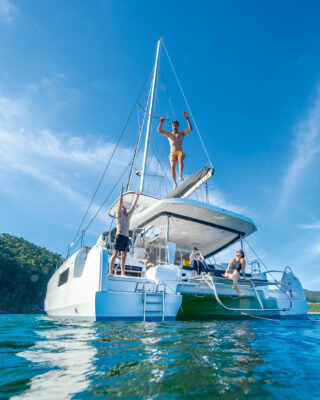
Photo: Lagoon Catamarans

Enjoy the comfort

Sometimes sailors can be a bit masochistic. Let that go. This dream involves two hulls – it’s time to get comfortable.

Before departure, try to relax. You don’t need to prep every meal in advance and psychologically prepare yourself for beyond three or four days of the usual motion sickness. Instead, think about activities to keep everyone busy and entertained.

You can cook, bake, eat, sleep, do yoga, workout, learn the guitar, or dance while underway (yes, I’ve done all of the above). This is a lifestyle.

Just one thing to remember: when sailing downwind the wind funnels through the saloon, so card games don’t work so well. Everything else? Go for it.

I feel so lucky to have spent so much time around people making this dream into their reality. It’s inspiring to see people brave enough to go after more from their life. So if you want to make that dream last you’ll need to invest in the skills to make it work. Docking, reefing, routing, anchoring – mastering these techniques will add a layer of safety, confidence and ease to your experience.


If you enjoyed this….

Yachting World is the world’s leading magazine for bluewater cruisers and offshore sailors. Every month we have inspirational adventures and practical features to help you realise your sailing dreams.

Build your knowledge with a subscription delivered to your door. See our latest offers and save at least 30% off the cover price.

Note: We may earn a commission when you buy through links on our site, at no extra cost to you. This doesn’t affect our editorial independence.
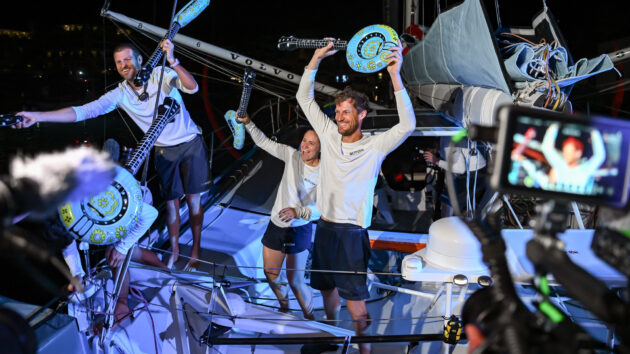
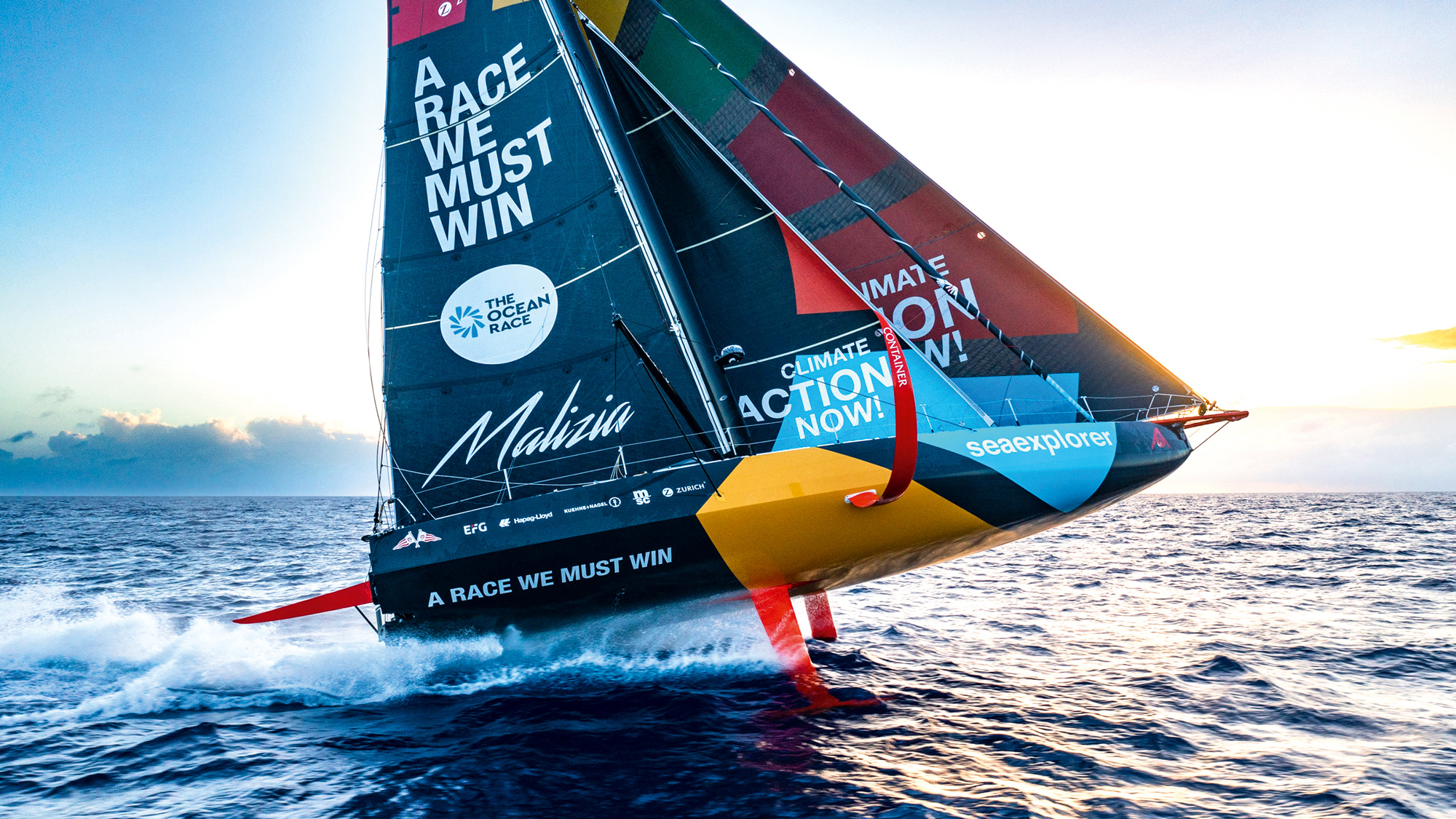
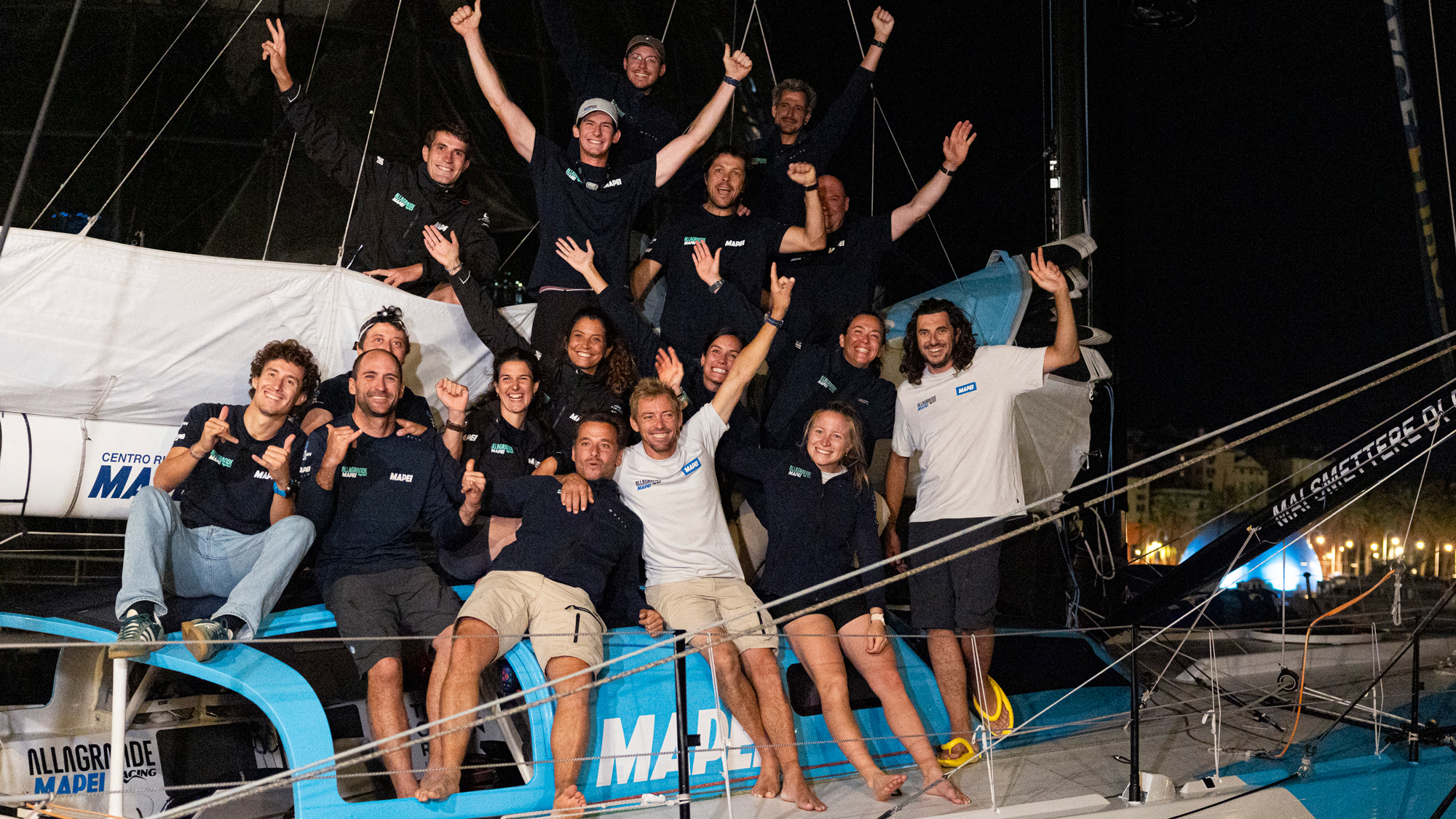
Biotherm wins the Ocean Race Europe Leg 5— and the rest of it

Final rankings, racing highlights, and the inside scoop on the race’s stopover in Genoa. Here’s everything you need to know about the end of the Ocean Race Europe 2025.

Biotherm is the official victor of the Ocean Race Europe 2025 having crowned an impressive overall performance with yet another first place finish at the end of Leg 5, as well as a first place win in the Coastal Race held in Boka Bay, Montegnegro.

Throughout the seven week, 4,500 nautical mile race around Europe, Biotherm has maintained a consistent overall lead, winning the first, second, and third legs of the race and collecting Scoring Gate points in each instance.

The only mark in the team’s neat run is a third place finish in Leg 4, which was instead a homecoming victory for Italian sailor Ambrogio Beccaria’s Team Allagrande Mapei. After the dramatic collision with Team Holcim-PRB early in the race, for which they were not granted redress, Allagrande finished fifth overall.

In second and third place were Yoann Richomme‘s Paprec Arkéa and Rosalind Kuiper’s Team Holcim-PRB. Team Malizia came in fourth, with Canada Ocean Racing and Team Amaala bringing up the rear.

Photo: Vincent Curutchet / The Ocean Race.

Biotherm skipper Paul Meilhat credits all-around collaboration between the shore teams and racing crew, as well as the boat’s preparation, for their triumphant victory.

“There are two parts of this victory,” he said, naming the organisation on shore and the boat’s preparation.

“Biotherm is more designed for this sort of race because it is really fast in transitions – light winds and flat water. We did a lot of improvements on the boat this winter. Also the crew, the motivation – I think we are all focused, we all concentrated, and we all wanted to win the race – that was the case from Kiel.”

How did the Ocean Race Europe end?

Final overall ranking of the Ocean Race Europe:

1. Biotherm – 55 points
2. Paprec Arkéa – 40 points
3. Team Holcim-PRB – 38.5 points
4. Team Malizia – 27 points
5. Allagrande Mapei Racing – 26 points
6. Be Water Positive – 18 points
7. Team Amaala – 9 points

Article contiues below…

Seven teams, six weeks, five legs, one unforgettable race. For its 2025 edition, the Ocean Race Europe will bring together…

Ambrogio Beccaria’s team Allagrande Mapei Racing made a triumphant finish to The Ocean Race Europe Leg 4 as they arrived…

The Ocean Race Europe Leg 5 at a glance:

    • Stopover events in Genoa highlighted the importance of ocean conservation, and how offshore racing can be a tool for environmental advocacy
    • The Ocean Race Europe Leg 5 started slow, with two days of light winds after the fleet left Genoa
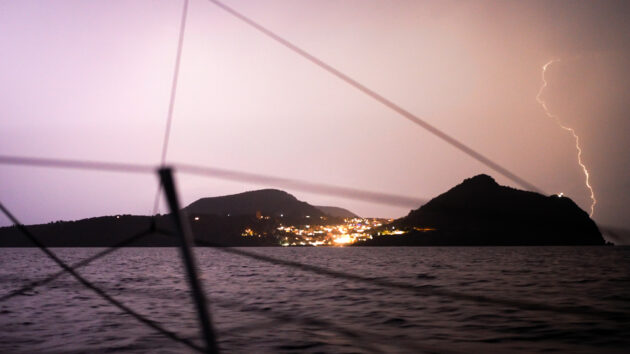
    • Thunderstorms, lightning, and torrential rains hit on Day 3, with teams reaching foiling speeds of up to 34 knots
    • The fleet segmented off of Sicily, with five boats in the leading group sailing ahead of a stormy transition zone and two teams, Amaala and Canada Ocean Racing, trapped far behind
    • A momentary overtake from Holcim-PRB off of Sicily reshuffled the fleet order
    • Tactical gambles from Allagrande and Paprec Arkèa failed to pay off
    • Biotherm was first into Boka Bay, followed by Holcim-PRB
    • The Coastal Race in Boka Bay brought a fresh wave of excitement and gave teams a last-minute chance to rack up points before the race’s end

The Ocean Race Europe Stops in Genoa

Photo: Jean Louis Carli / The Ocean Race.

The Ocean Race Europe fleet stopped in Genoa’s Porto Antico after an exciting finish to Leg 4, which saw leg winners Allagrande Mapei snatch first place after pulling ahead of Paprec Arkèa.

Allagrande and Genoa’s home-grown skipper Ambrogio Beccaria were greeted by an outpouring of local support, with fans, family, and media alike flocking to the race village for photos, pit lane tours, and speed tests in the Golfo Paradiso.

The stopover was also a launch pad for another Italian sailor’s upcoming endeavours.

Double olympian and Women’s America’s Cup sailor Francesca Clapcich, who also won the 2022-23 Ocean Race with 11th Hour Racing, supported her bid for the 2028 Vendée Globe with a presentation at the local maritime museum. Following the Ocean Race Europe, she will take over Malizia from current skipper Boris Hermann.

Photo: Marie Lefloch I Team Malizia.

Over four days, talks, screenings, and workshops from local activists, sponsors, and grassroots environmental groups highlighted the Ocean Race Europe’s guiding theme of sustainability. With both sailors and race officials advocating for ocean health in real time, and teams gathering valuable water samples offshore, the commitment to Racing for the Ocean was clear.

In a panel discussion following a special showing of David Attenborough’s Oceans, Holcim-PRB’s on board report Georgia Schofield stressed,

“We cannot keep sailing, keep enjoying the sea, without protecting our playground.”

Head to our socials for a behind-the-scenes look at the events and the action, including an exclusive cockpit tour with Team Malizia!

Departure from Genoa for the end of the Ocean Race Europe

Photo: The Ocean Race Europe.

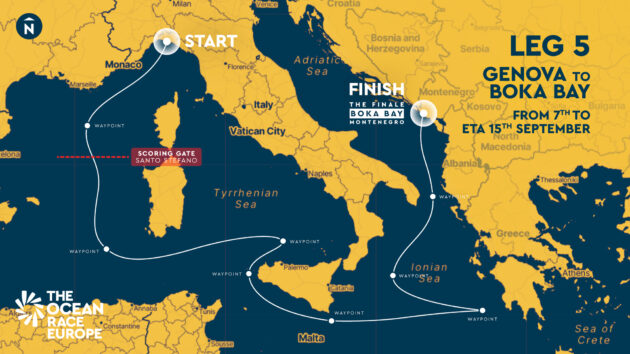
After the Genoa stopover, the Ocean Race Europe’s fleet of IMOCAs set off again for the race’s final leg, a 1,600 nm passage to Boka Bay, Montenegro that would take them down the volatile western side of Corsica and Sardinia, south of Sicily, and into the Adriatic Sea.

“It’s a long zig-zag of eight or nine days through the Med with a lot of curves and local effects and local winds – not a huge wind field but little patches here and there,” Boris Hermann explained.

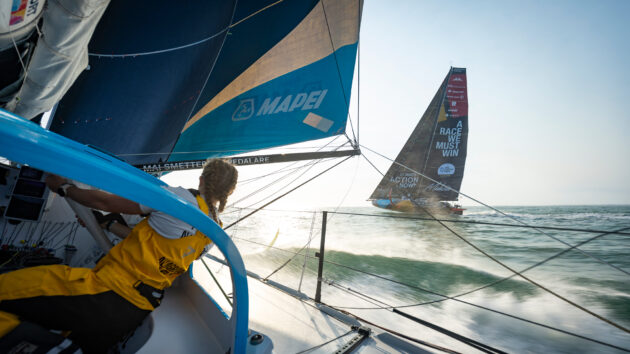
Leg 4 winner Ambrogio Beccaria’s Allagrande Mapei Racing made an early running start off the coast of Ligury, but the whole fleet was soon subdued by breezes barely scraping five knots. They inched along at three to four knots of speed throughout the night. Not quite a nail-biter!

Photo: Pierre Bouras / The Ocean Race.

Thunder, lightning, and broaches (oh my!)

After a quiet start, the front of the fleet hit a low pressure weather system packing winds over 30 knots that sent them tearing downwind.

‘We were going so fast that we caught up to the thunderstorm and the clouds,’ said Yoann Richomme of Paprec Arkea.

Reports of broaching, loss of control, and footage of crew members getting jostled about abounded.

An involuntary gybe on Paprec Arkea caused damage to a headsail sheet, as well as ripping the radar unit off its bracket on the front of the mast, while Holcim-PRB ended up on its side.

Photo: Gauthier Lebec / The Ocean Race.

The fleet was segmented by a thunderstorm line delineating two different weather regions.

Ahead of it, the first four boats in the fleet powered along in 30 knots of northwest wind.

Behind, cut off from the fresh downwind breeze, Holcim-PRB, Canada Ocean Racing, and Team Amaala were left chasing the fleet at half speed in just 12 knots of southeast.

Photo: Anne Beaugé / The Ocean Race.

An exciting overnight speed test saw Paprec and Allagrande fighting neck-and-neck in an exciting drag race.

“Both boats were doing 35 knots with maybe 100-metres of distance between us,” said Allagrande skipper Ambrogio Beccaria. “It was quite scary, unreal – one of the best sailing moments of my life for sure.”

Unstable conditions, thunderstorms aplenty, and frequent wind turns saw a reshuffling of the Leg 5 leaderboard as the Ocean Race Europe fleet came up on Sicily.

“You always need to be careful in these conditions – always one hand for the boat and the other for whatever it is you are doing,” warned Francesca Clapcich.

Holcim-PRB makes a comeback off Sicily

As they hit lighter winds under Sicily, Holcim-PRB made straight for the waypoint instead of tacking to the North like Allagrande, Biotherm, Malizia, and Paprec.

Skipper Rosalin Kuiper’s gamble quickly paid off– Holcim-PRB jumped from fifth to first place.

Photo: Jean-Louis Carli / The Ocean Race Europe 2025.

Biotherm retakes the lead towards Boka Bay

After rounding the final ‘India’ waypoint, the leading pack rearranged once again.

With Biotherm again in the lead, followed by Allagrande Mapei, Malizia, Paprec, and Team Holcim-PRB, the compressed fleet proceeded North upwind.

“These are good Biotherm conditions – flat water, medium wind – it’s perfect,” said Meilhat. “We have a lot of upwind now as we head to the North.”

Beccaria said he hoped instead for downwind conditions, hoping to pass closer to Italian shores. Allagrande eventually broke away from the rest of the front of the pack in search of more favourable conditions, but the gamble dropped them from third to fifth when the expected wind proved elusive.

Photo: Adrien Cordier / The Ocean Race.

Meanwhile, Canada Ocean Racing and Team Amaala crawled on at the back of the fleet.

To facilitate stopover activities in Boka Bay (and the expected Coastal Race), the Race Committee offered an alternative waypoint to give the two teams the option of shortening the race course, which meant the fleet trailers would trade an earlier arrival for the possibility of placing higher than sixth for the leg.

The Ocean Race Europe sails into the Adriatic sea

Photo: Pierre Bouras / The Ocean Race.

As the fleet entered the Adriatic, Biotherm was still at the front and covering their closest rivals tack for tack.

Paprec Arkèa gambled on an eastern route along the Albanian coastline with little success.

Not far behind, Holcim-PRB and Malizia jostled in an upwind match race, with sailors on both boats keeping a close eye on each other’s sail choice, boat speed, and angle.

While touring the boats during the stopover in Genoa, we learned that some teams like to keep their tricks up their sleeve, even changing or disguising their sail bags to keep their tactical choices a secret until the last moment!

The conditions required teams to stay on high alert to not lose their ground.

“You would think these are pretty steady, similar conditions, but it is not easy,” explained Holcim-PRB sailor Carolijn Brouwer. “The wind is up and down between nine and 12 knots. When we are sailing upwind when we get to 12 knots we are at the upper range of the big sail we have on – the J0. The wind is incredibly shifty – 20 to 25 degrees sometimes.

You really need to be precise and on top of it all the time, to react to the differences in pressure and the shifts in the breeze. That requires a fair bit of concentration and you have to be paying attention all the time.”

Biotherm wins final leg of the Ocean Race Europe

Photo: Julien Champolion / The Ocean Race.

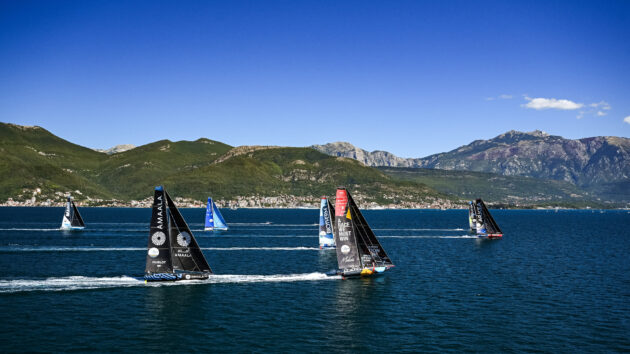
It hardly came as a surprise when Biotherm was first into Boka Bay, having completed the 1,600 nm leg in seven days, eight hours, 33 minutes, and 13 seconds.

Rosalin Kuiper’s Team Holcim-PRB took second place for Leg 5 after staging an impressive comeback to rejoin the leading pack. Third was Boris Herrmann’s Team Malizia; failed tactical experiments from Ambrogio Beccaria’s Allagrande Mapei and Yoann Richomme’s Paprec Arkea left them in fourth and fifth.

“It didn’t pay off,” Richomme commented. ‘But that’s racing sometimes.”

Nonetheless, Beccaria seemed satisfied with the sheer range of conditions teams faced during the Ocean Race Europe Leg 5.

“Leg 5 for us was a real Odyssey, a huge race where a lot of things happened. We had a lot of light wind and strong wind. All the way down to Corsica and Sardinia we had a lot of wind. On the way to Ustica we had a huge amount of wind and a super flat sea, so we were at 35 knots of steady boatspeed – it was unreal,” he commented.

The Ocean Race Europe’s Coastal Race in Boka Bay

Photo: Vincent Curutchet / The Ocean Race.

A Coastal Race upon the fleet’s arrival in Boka Bay closed out the racing events and gave teams a chance to grab last-minute points for their overall ranking.

The results of the Coastal Race pretty closely matched the overall leaderboard, with the only difference being team Allagrande Mapei edging out team Be Water Positive overall thanks to their Leg 4 win.

Even in close quarters, Biotherm once again came first, followed by Paprec Arkea, Holcim-PRB, and Team Malizia.

The Boka Bay Coastal Race results:

1. Biotherm
2. Paprec Arkéa
3. Team Holcim PRB
4. Team Malizia
5. Be Water Positive
6. Allagrande Mapei Racing
7. Team Amaala

What’s next for the Ocean Race?

Photo: Julien Champolion / The Ocean Race.

While the teams rest, reshuffle, and recover after their 7-week sprint around Europe, the Ocean Race events group is busy planning the upcoming calendar.

In November, The Ocean Race Summit Youth in Genova will explore how sport can be a platform for environmental change, and a tool to help build a more sustainable future for our world’s oceans.

In 2026, the first Ocean Race Atlantic will connect New York and Barcelona with a 3,200 nautical mile sprint. It will be the first point-to-point race in the 50-plus year history of The Ocean Race. Like the Ocean Race Europe, the event will feature mixed crews, though this time with a industry-first 50-50 gender split, as well as a focus on ocean conservation advocacy.

In 2027, the 15th edition of the iconic round-the-world Ocean Race will set off from Alicante, Spain.

“The Ocean Race is always on,” says Race Chairman of The Ocean Race Richard Brisius. “Our drive to protect and restore ocean health is a daily mission […] These events serve as inspirational touch points on the journey where we all get together with renewed focus and determination as we connect with the ocean.”


If you enjoyed this article on the Ocean Race Europe 2025…

Yachting World is the world’s leading magazine for bluewater cruisers and offshore sailors. Every month we have inspirational adventures and practical features to help you realise your sailing dreams.

Build your knowledge with a subscription delivered to your door. See our latest offers and save at least 30% off the cover price.

Note: We may earn a commission when you buy through links on our site, at no extra cost to you. This doesn’t affect our editorial independence.
Outteridge back in SailGP as Sweden become 13th nation to join foiling league

Nathan Outteridge, undisputedly one of the best foiling sailors of his generation, is re-entering SailGP as helmsman for the newly announced Swedish Artemis Racing team.

The Swedish Artemis entry becomes the 13th team to join the multi-stage, travelling stadium race series.

Artemis Racing will be led by CEO Iain Percy, himself also an Olympic gold medallist and previously Artemis Racing’s Team Manager during their America’s Cup campaigns.

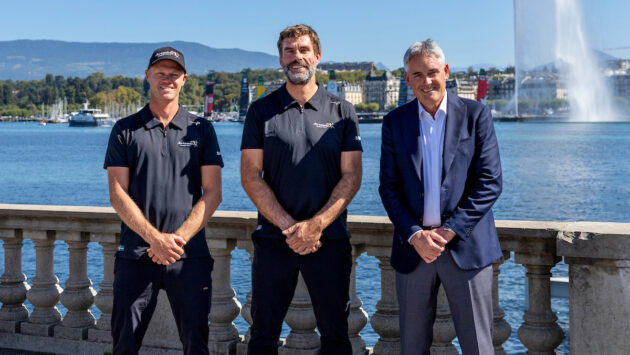
Nathan Outteridge (left) with Iain Percy CEO of Artemis SailGP Team and Russell Coutts (right), CEO of SailGP at the Artemis team announcement during the Rolex Switzerland Sail Grand Prix in Geneva. Photo: Felix Diemer/SailGP

Outteridge back in SailGP

Outteridge’s return to SailGP will be much welcomed, as one of the biggest talents in the sport right now.

His appointment pits three of the four finalist helmsmen in the 38th America’s Cup  against each other in the foiling catamaran league. Outteridge was co-helm to the Black Foils’ Pete Burling on the winning Emirates Team New Zealand AC75 last year, beating Ben Ainslie and Dylan Fletcher on INEOS Britannia, who currently manage and helm the GBR F50 respectively.

In the past two years Ainslie and former US skipper Jimmy Spithill stood down from racing in SailGP to take management roles, so the return of more Cup sailors with real star power will be a big boost for the circuit.

Nathan Outteridge (crouching) and Pete Burling celebrate after winning the America’s Cup in 2024 for Emirates Team New Zealand. Photo: David Ramos/Getty Images

Outteridge, who is Australian, is also a double Olympic medallist, winning a gold in 2012 and silver in 2016 in the 49er class.

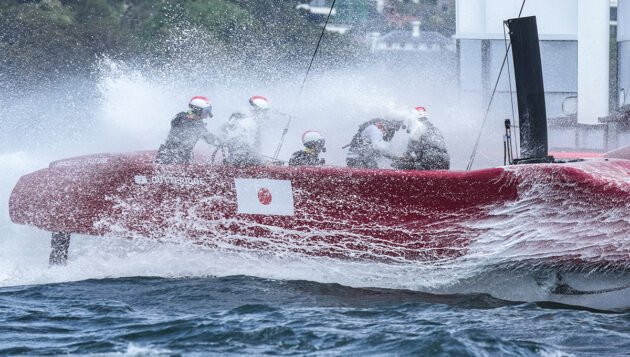
However, his SailGP career has not gone entirely smoothly. As helmsman and team boss for the Japan SailGP Team in Seasons 1 & 2 he delivered great results on the water, but the team was unable to attract sufficient commercial backing and had their boat reallocated to other teams, before being dropped from the league by founders – and funders – Larry Ellison and Russell Coutts.

Since then he has raced and coached other crews, but has not skippered a team for a full season, and took some time out to go cruising with his family.

Nathan Outteridge helms the Japan SailGP Team during a practice session in Season 2. Photo: Bob Martin/SailGP

Of his return to the global racing championship, Outteridge said, “Reuniting with Iain, Torbjörn and the Artemis team for this new chapter in SailGP is incredibly exciting. We’ve shared huge moments together in the past, and bringing that experience, trust and energy into this arena gives us a powerful foundation.

“This is a new challenge for all of us – a chance to showcase what Swedish sailing can achieve in one of the toughest and fastest stages in the world. We’re approaching this season with focus, ambition and the belief that we can set the standard for what’s possible in this championship.”

Swedish Artemis Racing

Artemis Racing has a huge history in cutting-edge racing. The team is backed by Torbjörn Törnqvist, a Swedish billionaire and passionate sailor who has raced in highly competitive classes such as the RC44s and TP52s (in which he won the World Championships and Med Cup with SailGP founder Russell Coutts as tactician).

Törnqvist founded the Artemis Racing America’s Cup team, which competed in several America’s Cups – including in 2013 and 2017 – with Percy and Outteridge on the crew.

Most recently Sweden challenged for the Youth and Women’s America’s Cups as an ‘invited’ team, finishing fourth in both.

Nathan Outteridge spent time as co-driver and sailing advisor t0 the Switzerland SailGP Team in 2022. Photo: Jon Buckle/SailGP

The Artemis SailGP Team will join the Rolex SailGP Championship for 2026, the sixth season of SailGP which opens in January 2026 in Perth, Australia

Artemis SailGP Team CEO Iain Percy commented: “I’m proud to lead the Artemis SailGP Team as we return to the global stage with a clear focus – leveraging cutting-edge technology, a world-class line up, and the hard-won lessons from America’s Cup.

“SailGP is redefining the sport with unmatched speed, innovation, and fan engagement. Bringing Sweden into this elite championship is a milestone we’re proud of, and we’re determined to compete at the very highest level – pushing boundaries both on and off the water.”


Contest Yachts’ five-star line-up for the three premier autumn shows

Contest Yachts, long celebrated for its deep family values and hands-on craftsmanship, will have a compelling presence at this autumn’s boat shows across Europe and the USA.

The Dutch semi-custom yard will bring four of its most storied models to three key boat shows. At the Cannes Yachting Festival, visitors will find the European Yacht of the Year 2025-winning Contest 63CS, alongside smaller sister and equally intriguing Contest 49CS. In Southampton, the multi-awarded Contest 55CS returns, while across the Atlantic at the Annapolis Sailboat Show, the Contest 50CS makes its US debut while participating in the Cruising World Boat of the Year 2026 programme which is judged during the show.

Cannes Yachting Festival: Contest 63CS & 49CS

From superyacht ideals to family cruising

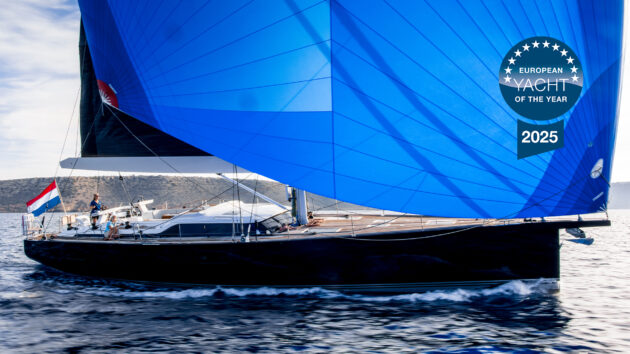
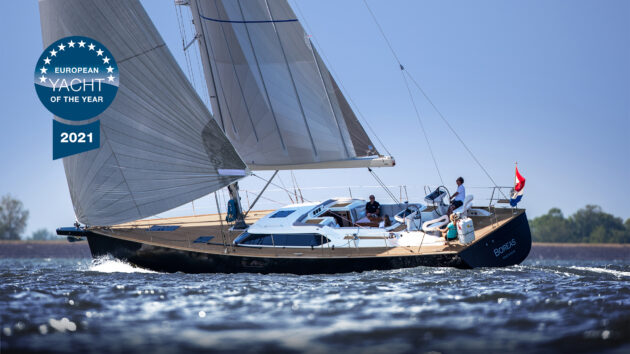
At this year’s Cannes Yachting Festival (9-14 September), Contest Yachts’ headline model will be the Contest 63CS, which since announced as the winner of the European Yacht of the Year 2025 – luxury category, continues to draw consistent media praise. Designed by judel/vrolijk & co with interiors by superyacht stars Wetzels Brown, the 19-metre luxury cruiser clearly impressed the award judges. Features that particularly stood out included this yacht’s innovative, transformable aft social deck and the pair of mirror-image VIP guest suites forward of the saloon. This is a very unusual layout at this length and one that sets the yacht apart.

The design’s performance and bluewater pedigree have also been widely praised. Reviewers highlight the 63CS’s ease of handling and effortless performance in even the lightest winds, supported by high-spec systems including electric winches and hydraulic furlers. Below decks, the tranquil ambiance is a hallmark of a Contest yacht, while expansive coachroof glazing delivers superb natural light. As one reviewer put it, “Lusso allo stato puro… naviga con una leggerezza che non fa pensare a un peso… pure luxury sailing with lightness that belies its weight”.

The Contest 63CS

Yachting World’s test team also praised the yacht’s “superyacht-level finish” and smartly thought-through ergonomics revealed at the 63CS’s initial Cannes debut last year. This momentum is amplified by the yard’s rich heritage, as Yachting World’s test editor Toby Hodges observed, “Contest Yachts is one of the largest and oldest family-run yards in the world, and conducts the whole build process on site – a yard with a rich past and a promising future.”

Such words underscore that the 63CS isn’t just a design milestone – it is the culmination of 65 years of craftsmanship, innovation, and bluewater leadership.

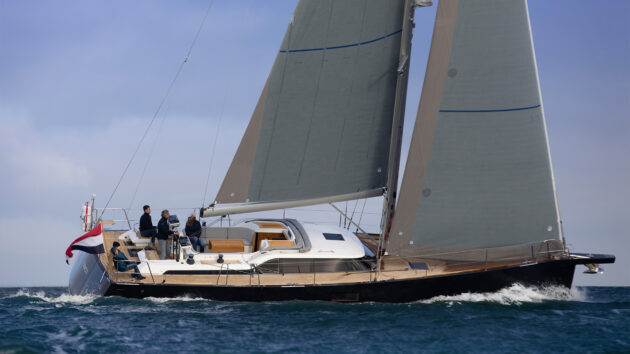
Complementing the 63CS at Cannes will be the Contest 49CS, the yard’s first model in the 50-foot sector spinning the cabin arrangement to feature twin aft cabins and a forward owner’s suite, making it equally attractive for family voyaging or sailing with friends. A particular strength of the 49CS’s layout is that Contest has retained its hallmark dual-cockpit style with a spacious aft deck, generous lounging area, tender garage, and fold-down bathing platform – all while preserving the twin-helm’s secure position forward, a defining Contest trait.

Built with the same high-spec composite construction and Lloyd’s Register certification as its larger sister, the 49CS delivers exceptional volume and ergonomics for its class, a superb family cruiser with elegant detailing and serious performance credentials.

Contest 49CS

Southampton International Boat Show: Contest 55CS

Award winning design returns to UK waters

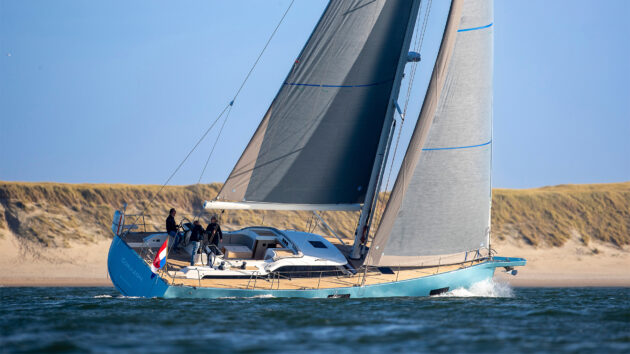
At the Southampton International Boat Show (19–28 September), Contest Yachts will present the Contest 55CS, a bluewater cruiser that has already earned significant accolades – including the European Yacht of the Year, and British Yachting Awards, again in the luxury performance category. At 17 metres, the 55CS offers the same power, performance, and build ethos synonymous with Contest’s evolved lineage.

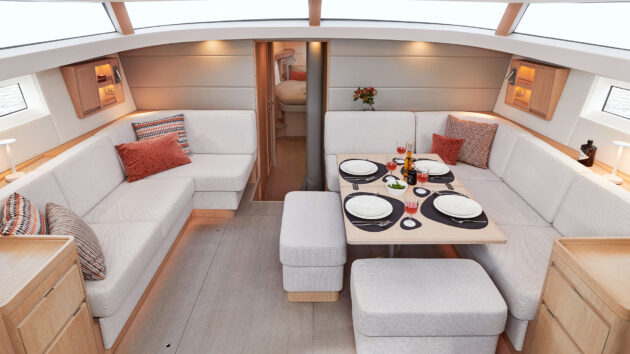
Inside the Contest 55CS

Designed by judel/vrolijk & co and crafted to exacting Lloyd’s Register standards, the 55CS blends sumptuous styling, exceptional ergonomics, and robust sea-going ability. Inside, light-filled cabins with expansive hull windows and eyeline wraparound glazing are paired with Wetzels Brown’s thoughtful interior styling to deliver effective, practical opulence. The yacht also boasts intuitive control systems and meticulous soundproofing for a markedly quiet onboard experience, even under way. It’s a hallmark of the yard’s refinement: a delight below decks – restful, calm, with only the faint fizz of the passing seas.

Contest also emphasises owner operation as a cornerstone of its design. High-specification soft- and hard-ware run throughout, with powered systems at fingertip reach, retractable bow thrusters, self-furling gear, and automated conveniences all ensuring ease, confidence, and simplified maintenance. It makes for a superyacht-standard package, delivered in a size perfect for capable owner-sailors.

The Contest 55CS

Annapolis Sailboat Show: USA Premiere of the Contest 50CS

A new generation dual centre cockpit contender

In the USA, the flagship arrival will be the Contest 50CS, making her American debut during the Annapolis Sailboat Show, where she’s also an invitee in the prestigious Cruising World Boat of the Year 2026 programme.

This latest-generation 50-footer revitalises the centre-cockpit concept with superyacht-inspired volume, assured performance – both upwind and downwind in all conditions, and with low angles of heel – and a remarkable ease of handling that allows even for confident single-handed sailing.

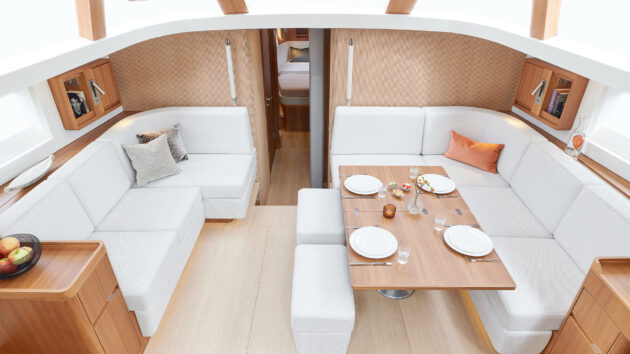
Below on the Contest 50CS

Judel/vrolijk’s modern hull form pairs with Wetzels Brown’s light-filled interiors, delivering a yacht that is as elegant as it is seaworthy. A generous aft master suite, a welcoming forward guest cabin, and the option of a third cabin reflect the yacht’s balance of luxury and practicality. On deck, twin helms, a clean walkthrough cockpit, protective curved-for-comfort coamings, and power-assisted sail handling all ensure safety and control. Below, carefully engineered composite structures and extensive noise-damping measures create a calm, near-silent motion under way.

Every element is conceived for long-range comfort and bluewater reliability, from the hydraulic transom platform to the neatly integrated stowage solutions throughout. The result is a contemporary cruiser that brings Contest’s hallmark craftsmanship and Lloyd’s Register-certified build quality to a size as manageable for a couple as it is welcoming for family and friends.

Contest 50CS

A rich past, a promising future

So, the Autumn 2025 Show Season sees Contest Yachts confidently presenting its latest models on the world stage, bringing together a fleet that bridges heritage with forward-looking design. The 63CS demonstrates the yard’s mastery of superyacht finish in a manageable length. The 49CS introduces a fresh family-friendly platform at the heart of the range. The 55CS continues to embody award-winning performance and practicality. And the 50CS, with its US premiere, signals Contest’s increasing presence in North America.

As Yachting World’s Toby Hodges observed when testing the 63CS: “Contest Yachts is a yard with a rich past and a promising future.” This autumn that future is firmly on display with a show line-up that promises to inspire sailors on both sides of the Atlantic.

Chat/call The AYB Team